
The news pictures continued, but the voice no longer belonged to the newsreader. It claimed to speak for the Ashtar Galactic Command and warned humanity to change its ways. Who had found a way into Southern Television’s signal?
An intruder at teatime
On Saturday 26 November 1977, viewers in part of southern England heard an unexpected voice during the early-evening news. It sounded slow and strange, and it had a message about the future of the human race. Weapons had to be abandoned. People had little time to learn to live peacefully. The speaker presented itself as the representative of a command from beyond Earth.12
The interruption was real. Reports appeared in the newspapers immediately afterwards, describing calls to Southern Television and the police. Broadcaster and engineers investigated. What reached television sets was not simply a story somebody later claimed to have heard in the countryside. An unauthorised message had entered a service that viewers reasonably expected to be under the broadcaster’s control.12
Its most unsettling feature was the separation of sound and picture. The news images remained while another voice spoke over them. In the account later published by broadcast historian Jason Robertson, Andrew Gardner was reading the bulletin when the intrusion began. The effect did not require an alien face or a spacecraft appearing on screen. The familiar television picture became the carrier of an unfamiliar authority.3
The voice is now generally known as Vrillon. Contemporary reports did not agree. The Birmingham Sunday Mercury recorded a witness hearing Asteron; the Reading Evening Post called the intruder Gillon. Even the organisation’s name appeared in different forms. Those variations would later matter, because an indistinct name can acquire a fixed spelling when successive writers copy one transcript.124
There was also no single uncontested timing. The Sunday Mercury described an interruption lasting more than six minutes. The Reading report gave about three minutes and a starting time of 5.08pm. Robertson’s later reconstruction used 5.12pm and five and a half minutes. The broad sequence is secure; the precision frequently supplied in modern retellings is harder to justify.123
Whatever its exact duration, the message did not arrive as an invited interview or a clearly announced drama. It came through the sound of a routine news transmission. Viewers had to decide, without the benefit of a later newspaper explanation, whether they were hearing a station announcement, a technical fault, a threat or something else altogether.1
Southern Television apologised afterwards for interference to sound. Engineers did not describe themselves as having invited a cosmic spokesman onto the programme. The questions were where the interference had entered the distribution system, how it had been produced and who was responsible. The gap between those practical questions and the voice’s grand claims would give the episode its lasting appeal.12
No expedition had to recover a hidden artefact. No witness had to persuade an investigator that a light in the sky was unusual. For a few minutes, an ordinary domestic set supplied the apparent encounter. The equipment belonged to the household; the programme belonged to a licensed broadcaster. The speaker belonged to neither.13
That made the incident different from an isolated claim of telepathic contact. Many people could hear the same interruption, yet collective reception still could not authenticate the identity being announced. A real unauthorised broadcast and a genuine message from another world were separate propositions. The first was established almost immediately. The second was what the intruder wanted listeners to accept.12

Calls from the living room
The next day’s Sunday Mercury reported hundreds of worried calls to Southern Television and more than fifty emergency calls to police in Winchester. These were newspaper figures, not a surviving switchboard log reproduced with the account. They nevertheless show how the incident was presented before it had accumulated decades of UFO folklore: an unsettling transmission had prompted people to seek an explanation.1
One named witness was Janet Stewart of Basingstoke. She described her daughter Donna becoming frightened and said the voice continued through the news, advertisements and the beginning of the cartoons. The report gave the disturbance a recognisable setting: a family watching a normal Saturday programme, then suddenly unsure who was speaking through the television.1
That testimony supports an intrusion extending beyond a single news sentence. It cannot settle every subsequent claim about the number of people who panicked. Newspaper accounts selected the most striking reactions, and headlines naturally favoured the apparent visitor from outer space. A frightened household is evidence of a frightened household. It is not a census of the entire transmission area.1
The Reading Evening Post also described calls to police stations and the broadcaster’s Southampton headquarters. Its account located the point of interference at Hannington, near Newbury, rather than in the news studio itself. By the time it appeared on 30 November, the paper’s emphasis had shifted towards engineers believing they understood how the prankster had got into the system.2
The difference in emphasis is revealing. A voice heard at home might seem to have entered the whole television organisation. A broadcast network, however, consisted of different links and transmitting sites. An intrusion affecting one part of that chain did not necessarily mean that Southern’s studio, ITN’s news operation or every transmitter serving the region had been taken over.23
Hannington became central to the explanation. Police went to the transmitter after hearing about the broadcast, according to the Reading report. They found nobody there. That observation did not prove a remote or otherworldly source. A short unauthorised transmission could end before officers arrived, and the absence of somebody beside the mast was not the absence of a terrestrial method.2
Southern’s spokesman said engineers had a reasonable understanding of what had happened but would not release details that might encourage imitation. The same account said steps were being taken to prevent another occurrence. The report contains both a claim of technical understanding and a deliberate limit on public disclosure. Later writers could emphasise either half.2
Was the secrecy itself suspicious? It could certainly leave listeners with unanswered questions. It also had an ordinary explanation in the account: the broadcaster did not want another person to exploit the same weakness. Withholding operational detail in that situation is not evidence that engineers privately accepted an alien origin. It is a statement about protecting a service after interference.2
The contemporary reporting also defeats the idea that nobody noticed anything until much later. Viewers called, a broadcaster apologised and police attended a transmitting site. What remained uncertain was not whether an incident had happened. It was how much the publicly available explanation established about the person behind the voice.12
By the following week, a more detailed newspaper account claimed to have found the kind of people who could do it. Its story involved students, electronics enthusiasts and a vehicle near the transmitter. The galactic warning was already acquiring a rival origin story, rooted in a very earthly culture of illicit broadcasting.5

A way into the signal
On 4 December 1977, the Sunday Times published a report by Peter Gillman and Paul Eddy about the intrusion. It described a group of students and electronics enthusiasts using inexpensive equipment to interrupt the sound. A later issue of the vintage-television journal 405 Alive reproduced the report, preserving an account much more specific than the often-repeated claim that engineers had no idea how it was possible.5
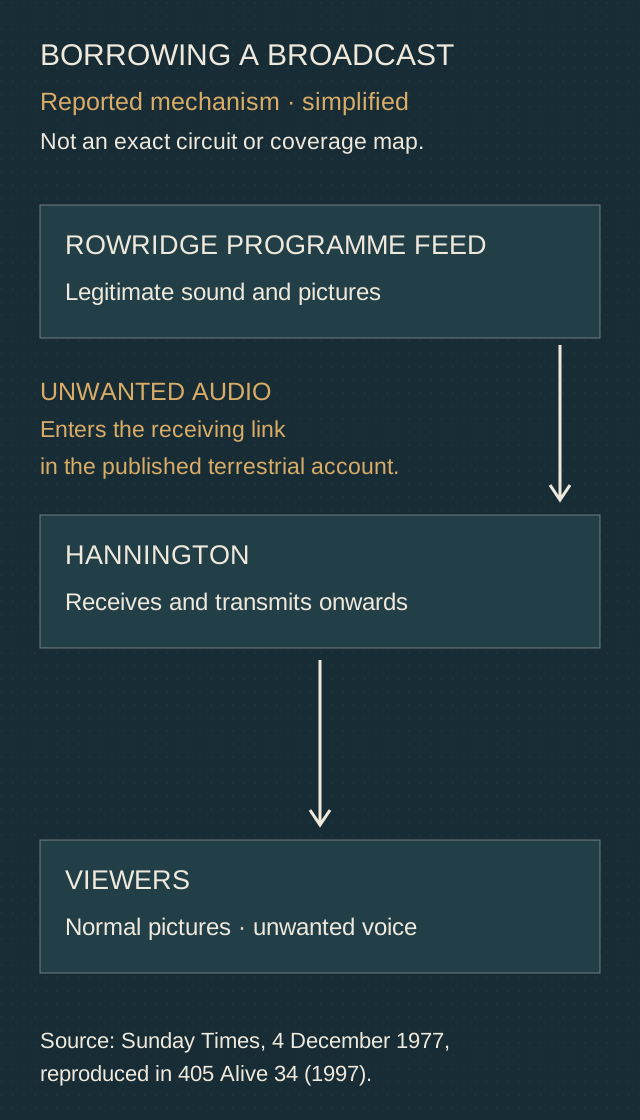
The newspaper’s explanation placed the intruders near Hannington. It said the station received a programme signal from Rowridge on the Isle of Wight and that the pirates interfered with that incoming link. The station then transmitted the unwanted sound onwards. The proposed weakness lay in the way one transmitter obtained its programme, rather than an invasion of the studios.5
The principle is easier to understand if the two stages are kept separate. A transmitter’s audience receives the programme it sends out. Before it can do that, the transmitter must obtain the programme from somewhere. If that incoming feed is taken off the air, interference at its receiver can be passed along to a much larger audience. The intruder need not reach every living room individually.5
This is why a modest local operation could appear much more powerful than it was. The established broadcaster supplied the final distribution. An outsider who reached a vulnerable point in the chain could borrow that reach. The geographical extent of the reception would therefore say more about the transmitter being misused than the cosmic distance from which the speaker claimed to have come.5
The Sunday Times account also distinguished sound from vision. The unauthorised speech accompanied the legitimate pictures. It described safeguards and monitoring arrangements that made the two parts of a television service different targets. That distinction matters because later descriptions of a television takeover can imply a complete replacement of the channel, including images that the 1977 intruder never supplied.5
The report went further than a theoretical demonstration. It described the warning as a prerecorded performance, with the speaker’s voice slowed and electronically altered. It also linked the group with earlier radio interruptions. These are claims made by the newspaper’s investigation. They should not be quietly upgraded into an identified perpetrator’s signed confession or a published police finding.5
The anonymous group was not named in the reproduced report. Readers were given a striking explanation of how a prank could work and a description of those said to have carried it out, without a publicly verifiable list of participants. That is more evidence than an unexplained voice, but less than a case file connecting named individuals to seized equipment.5
Later broadcasting accounts are not completely consistent either. Robertson’s retrospective article discussed interference high in a distribution chain but described a broader VHF reach. The contemporary Sunday Times reproduction centred the operation on Hannington and the Rowridge link. The difference is a reason to preserve attribution, not to combine every technical detail into one supposedly definitive reconstruction.35
What survives across these accounts is a workable terrestrial mechanism. An outside signal could enter an existing broadcast path, and alteration of a recorded human voice could produce the strange sound. Nothing in that explanation requires a spacecraft, an impossible communications system or a person physically breaking into the news studio.35
The engineering explanation did not answer the question that would outlive it: who actually made the message? It left a space between an account of a possible operation and proof of a particular operator. That space was large enough for both another human investigation and a much less restrained mythology.5
Ashtar before Hampshire
The name announced by the intruder was not new. Twenty-five years before Southern Television’s viewers heard about a Galactic Command, American contactee George Van Tassel had published messages attributed to beings from beyond Earth. His book I Rode a Flying Saucer presented the communications as information received through unusual mental contact, rather than signals recorded by an independent astronomical instrument.6
Van Tassel described himself as an aviation worker who had settled with his family at Giant Rock in California. His introduction linked the quiet of the desert with his ability to recognise a deeper reality. The setting was important to his account of contact: distance from ordinary urban life helped explain why he, rather than a scientific institution, might receive such messages.6
A communication dated 18 July 1952 identified its speaker as Ashtar and supplied an elaborate command structure. Stations, sectors and patrols gave the message the vocabulary of an organised service. The supposed visitor was not merely reporting a beautiful distant world. It claimed authority over a crisis that human governments were failing to manage.6
The crisis was nuclear destruction. Van Tassel’s Ashtar warned about hydrogen weapons and demanded that information be passed to governments. The text mixed assertions about atomic processes with a spiritual division between enlightened beings and destructive materialists. Its physical claims were not established by their confident presentation. What the booklet establishes is that this rhetoric was in circulation long before 1977.6
The resemblance to the later broadcast is therefore significant without being conclusive. Both offer intervention by higher intelligences, concern about humanity’s dangerous behaviour and an urgent opportunity to change course. A listener familiar with contactee literature could recognise the family resemblance. Somebody composing a convincing imitation could use the same familiarity to their advantage.64
The surviving version of the 1977 message invokes a coming spiritual awakening and the New Age of Aquarius. It warns about misleading teachers and exploitation, then encourages listeners to seek truth within themselves. This is a moral and spiritual address, rather than a technical announcement containing coordinates, a verifiable scientific discovery or an agreed method for a reply.4
“You have but a short time to learn to live together in peace and goodwill.” From the later published transcript.4
The message combines reassurance with pressure. Humanity is offered peaceful development, but the opportunity is presented as limited. That combination can feel ominous without threatening a conventional invasion. It also makes the speech flexible: a sympathetic listener can hear guidance, while a startled viewer can hear an ultimatum from somebody who has interrupted a trusted service.4
This background offers no direct identification of the British intruder. Van Tassel’s publication does not connect him with Hannington, and the reuse of Ashtar does not prove that one particular organisation arranged the transmission. A name already circulating in books and UFO communities could be adopted by a believer, a satirist or somebody interested primarily in the technical challenge.6
Nor does recognition authenticate the claimed source. If a message contains the familiar ideas of a spiritual movement, it may be a new communication accepted within that movement. It may also be a performance assembled from its vocabulary. Shared language is evidence of a connection between texts and ideas, not proof that an unseen commander exists outside them.
The question of motive was consequently harder than the question of method. Was somebody trying to spread a sincere warning, mock a culture of contact claims or demonstrate that the television system could be fooled? A voice announcing a cosmic mission could conceal any of those intentions. The performance supplied its own explanation, but that explanation was part of what needed investigating.45

A pirate behind the command?
The December newspaper report favoured a prank. It said the group had considered a more overtly political announcement before choosing a flying-saucer spoof. If accurate, that would explain why the content sounded like a warning while the operation itself resembled an exercise in technical mischief. But the account left the alleged participants anonymous.5
That anonymity allowed the story to settle into an apparently permanent mystery. An available engineering explanation and an unknown operator were repeatedly collapsed into one statement: the broadcast had never been explained. The stronger version made the episode seem to resist ordinary investigation. It also overlooked how much had already been reported about terrestrial interference within days of the event.25
Decades later, Tommie Trelawny’s podcast The Interruption reopened the case. Its late-2022 episode descriptions announced a solution involving a former pirate broadcaster who later became known for discussing gadgets. An epilogue released in February 2023 presented an additional encounter with a witness. The investigation was no longer simply asking whether a human could have done it.7
A 2024 published recap of that investigation named Bob Tomalski, known in pirate radio as Roger Tate, as the proposed broadcaster. The identification is material to any current account. It means that a categorical claim that nobody has ever named a plausible individual is out of date, even if readers still want stronger documentation for the attribution.8
Tomalski’s memorial preserves a recognisable figure from broadcasting and technology journalism. A tribute recalled his spoof report about a wooden Russian camcorder, complete with a model made for the photograph. He died in 2001, long before the podcast investigation. The tribute establishes his career and taste for a technical joke; it does not identify him as the television intruder.11
According to that recap, the podcast spoke with people who had known Tomalski in radio. One recalled him possessing and playing a recording of the interruption; another, identified as Adam, said Tomalski had admitted responsibility. These are reported recollections of a dead man’s statements and activities. They deserve evaluation as testimony, not conversion into a confession recorded during the original investigation.8
The distinction does not make the account worthless. A person with the right practical background, a relevant recording and an alleged private admission is a much more specific lead than a vague rumour about students. It supplies an individual, a social setting and people whose accounts could be compared. That is how a later human investigation can change an old mystery.8
It also leaves questions that the attractive fit cannot answer alone. A recording might have been an off-air copy, a working tape or a later version. Technical ability shows opportunity to understand the operation, not automatically participation. A recollection of an admission is strongest when its wording, date and circumstances can be checked, particularly after several decades.8
The producers described their case as solved. That is their conclusion, and it should be reported as such. It is different from a published finding by the 1977 investigators or a contemporaneous document naming Tomalski as the operator. The proposal can be credible without erasing the distinction between a later journalistic identification and the surviving official record.78
Could several people have been involved? Both the older newspaper’s group account and the later recap leave room for collaborators. A radio project could involve a writer, a voice performer, equipment and help with transport. But a possible division of labour is not evidence naming additional people. It would be careless to turn acquaintances in a radio scene into accomplices by association.58
The resulting picture is more interesting than either complete bafflement or a neat official solution. There was a contemporary human explanation, an anonymous claim about a group and a later investigation advancing a named candidate. The sensible next question is what independently checkable material can connect those accounts, rather than whether the name Ashtar makes the whole operation impossible.578

Which message survives?
The recording trail presents another problem. A sound file placed online is not self-authenticating. To reconstruct the event precisely, an investigator needs to know who made the recording, what equipment captured it, whether it was edited and how the file reached its present form. A convincing voice and a familiar date in a filename cannot supply that history.
Transdiffusion’s archive page carries an audio file credited to mb21, alongside contemporary newspaper material and a much later transcript. Those are different kinds of evidence sharing one page. The newspaper texts establish what was reported in 1977. The transcript supplies wording in circulation decades afterwards. The credited file does not, on that credit alone, establish an unbroken chain back to a household recorder on the evening.4
This matters particularly when somebody adds a picture. The original intrusion replaced sound while normal television images continued. A later video may illustrate the event, recreate it or combine material from different sources. It cannot become an original off-air recording simply because it includes an old television ident or a newsreader. The image track needs a history as well as the sound.35
The names provide a visible warning. Asteron and Gillon appear in the early newspaper reports. Vrillon became the familiar spelling in the widely circulated transcript. The 405 Alive compilation also reproduced another version naming Gramaha, attributed there to Aquarius magazine. That version included passages and emphases absent from the later transcript. The differences should not be concealed by selecting a favourite as unquestionable.1245
The same applies to duration. Time spent hearing a message, the total period of interference and a rough estimate given to a reporter need not be identical measurements. Different figures might reflect those distinctions, but that is an explanation to test, not a reconciliation already proved. A complete recording with reliable provenance would be better evidence than increasingly confident repetitions of six minutes.123
A recording may also be useful without being complete. A short clip could establish a phrase, a voice effect or the relationship between unwanted speech and normal programme sound. What it cannot safely do is establish every word of a longer message it does not contain. Transcripts should state what they were made from rather than quietly become substitutes for missing sections.
There is a further risk in identifying an actor from a processed voice. Speed changes and electronic effects can alter precisely the characteristics listeners might otherwise use to recognise someone. The contemporary Sunday Times account described such manipulation. A resemblance might guide a search, but a bare assertion that the voice sounds familiar is a poor substitute for a documented connection.5
None of this puts the occurrence of the intrusion in doubt. Multiple contemporary reports, the broadcaster’s response and investigation establish that independent of the copies now circulated online. It does mean that the most memorable modern version of the speech should not automatically dictate the exact sound, spelling and length of the 1977 event.12
The mystery of a programme interruption can become the mystery of an archive. Once the first recordings and working papers are dispersed, later copies acquire a weight they were never intended to carry. A new witness, original tape box or clear transmission log could then be more valuable than another dramatic reconstruction of the same well-known story.

A warning from somewhere else
The extraterrestrial explanation begins with one undisputed fact about the performance: the speaker claimed to represent a Galactic Command. That statement tells us the identity adopted for the broadcast. It does not identify the place where the signal was generated, the person reading the words or the origin of the ideas. Those require evidence outside the claim itself.4
The strongest argument for taking it literally is its apparent intrusion into an established television service. A listener might reason that an ordinary person could not gain access to such a system, so an extraordinary source was required. The contemporary terrestrial account answers that point directly: the target was a vulnerable link in distribution, and the audience was reached through the broadcaster’s own transmitter.5
The absence of an immediate arrest does not undo that mechanism. It establishes that naming a responsible person was more difficult than describing how interference could occur. A prank can be technically explicable while its author remains unidentified. The later Tomalski attribution, whatever weight it ultimately earns, also moves the question towards a particular human operator rather than an inexplicable form of communication.58
Could a sincere UFO believer have made the broadcast? Certainly the surviving speech has the vocabulary of contact literature. But sincerity is not encoded in that vocabulary. Someone could broadcast a message they believed important, or imitate the same message because it would be recognisable and amusing. The contemporary spoof account favoured the latter; the wording alone cannot choose between them.456
An authorised publicity stunt is another conceivable human explanation, but it faces a different evidential burden. Newspaper reports describe investigation, concern and apologies. No production record or credited broadcast plan is supplied by those accounts. Proposing a stunt would require evidence connecting the responsible broadcaster or another organisation with the intrusion, rather than assuming that unusual publicity must have been arranged.12
Nor does a refusal to publish security detail establish a government operation. Southern’s stated reason was to avoid another hoax. That explanation can be assessed without imagining a hidden intelligence programme. A cover-up claim needs material showing what was concealed and by whom, not merely a space where an interested reader would like more documentation.2
The cosmic interpretation also has to account for the content’s prehistory. Ashtar’s warnings were already available in print in the 1950s, framed by human fears about destructive technology and the need for spiritual change. The television speech did not introduce that combination to the world. Familiarity with it offers an ordinary route by which a human scriptwriter could construct a convincing message.6
This leaves room for curiosity without treating every possibility as equally supported. The intrusion was unusual, the performance was effective and the identity question attracted genuine later research. The published terrestrial accounts have explanatory value that an asserted intergalactic command does not gain merely by being more dramatic.257
What made the warning powerful was its position. It borrowed the reach of a transmitter and the attention already gathered around the evening news. The speaker did not need to establish a new audience or persuade people to attend a séance. It arrived where an audience already was, temporarily making an ordinary television set seem to speak on behalf of somebody outside the familiar world.15
Where the voice went
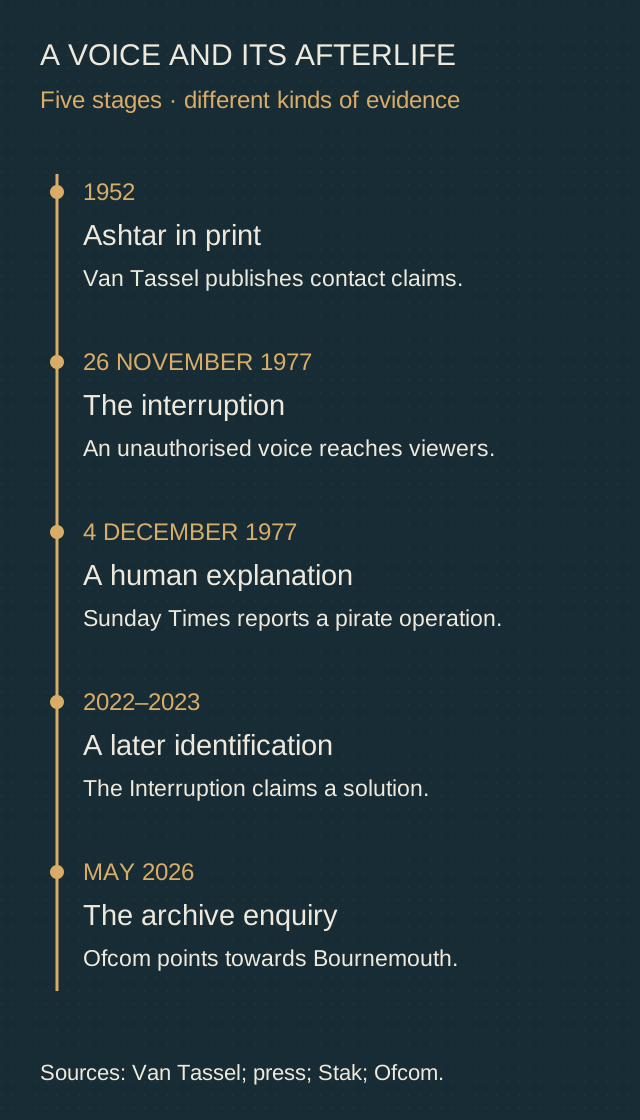
There is a recent official record, although it is not the one many retellings imply. On 11 May 2026, Ofcom answered a freedom-of-information request asking about a recording and other archival material concerning the interruption. The regulator said it did not hold the requested information. It directed the requester towards Bournemouth University, which had received material from the former broadcasting authorities.9
That answer should not be enlarged into a statement that no evidence survives anywhere. It describes what Ofcom held and points to a different custodian. An archive transfer is an ordinary reason why a present-day regulator might not possess a predecessor’s papers. The letter neither authenticates a circulating recording nor rules out material in other institutional or private collections.9
Bournemouth’s archive guide describes a large, incompletely catalogued paper collection covering the Independent Television Authority, Independent Broadcasting Authority and Cable Authority. It is not a fully digitised store that can be exhaustively checked through a few web searches. A failure to find the word Vrillon in an online catalogue would not establish that no relevant engineering correspondence exists.10
As of November 2026, the university’s published notice says its archives service is temporarily closed, with reopening expected in early 2027. That is a practical limitation on the next stage of research, not evidence of an extraordinary embargo. A productive request would concern the programme interruption, Hannington, engineering responses and correspondence, rather than rely only on the name supplied in a later transcript.10
The records already consulted support a clear distinction. The broadcast happened; engineers and journalists described terrestrial interference; the speaker’s organisation was a claimed identity. Later investigation offered a named candidate and claimed a solution. Neither the available official letter nor a retelling of the podcast, by itself, supplies a complete contemporary evidential chain naming every participant.125789
A stronger identification might come from original production material, equipment records, consistent independent testimony or papers from the 1977 inquiry. A recording with a demonstrable history could clarify the wording as well as help evaluate a claimed connection with its maker. Those are specific kinds of evidence that could change the reconstruction. Another anonymous upload would add much less.
There is no need to preserve uncertainty by pretending that the technical explanation never existed. Equally, the most confident later identification should remain attached to the investigation that made it. The episode is a history of an intrusion, its reporting and its reinterpretation, rather than an untouched puzzle waiting in precisely the condition it occupied in November 1977.57
The evening news regained its own voice. The household sets went back to carrying ordinary programmes, while the message continued through newspapers, specialist magazines, tapes and later the internet. Each new setting made the warning easier to encounter and harder to separate from what had been added to it. The broadcast lasted minutes. Its afterlife has lasted decades.145
Who spoke for Ashtar? The strongest available accounts point back towards people, transmitters and a deliberately altered voice. The name announced a cosmic authority. The enduring human question is who borrowed it, and what evidence can finally connect the performance heard in living rooms with the hands that put it on the air.58
Follow the evidence
Sources & further reading
- TV voice from outer space starts a panic Birmingham Sunday Mercury · 1977-11-27 · Accessed 2026-11-06
- Engineers solve mystery TV interference Reading Evening Post · 1977-11-30 · Accessed 2026-11-06
- Hijack Jason Robertson · 2001; updated 2004 and 2022 · Accessed 2026-11-06
- Southern interference: later transcript and audio credit The Transdiffusion Archives; transcript credited to David Barnett · 2023-08-21 · Accessed 2026-11-06
- Student boffins show how easy it is to break into television, reproduced in 405 Alive 34 Peter Gillman and Paul Eddy, The Sunday Times; 405 Alive edited by Andrew Emmerson · 1977-12-04; reproduction 1997 Q2 · Accessed 2026-11-06
- I Rode a Flying Saucer George W. Van Tassel · 1952; online transcription · Accessed 2026-11-06
- The Interruption: episodes seven, eight and nine, official episode feed Tommie Trelawny / Stak · 2022-12-19 and 2023-02-20 · Accessed 2026-11-06
- Coming to You Live from Ashtar Galactic Command: More Signal Interruptions Ridiculous Crime / iHeart · 2024-04-25 · Accessed 2026-11-06
- A Southern television interruption tape: FOI response 02189346 Ofcom · 2026-05-11 · Accessed 2026-11-06
- Independent Broadcasting Authority Archive: access guide Bournemouth University · Updated September 2026 · Accessed 2026-11-06
- Tributes to Bob Tomalski Hi-Fi & A/V and David Murphy, reproduced on memorial site · 2001 · Accessed 2026-11-06