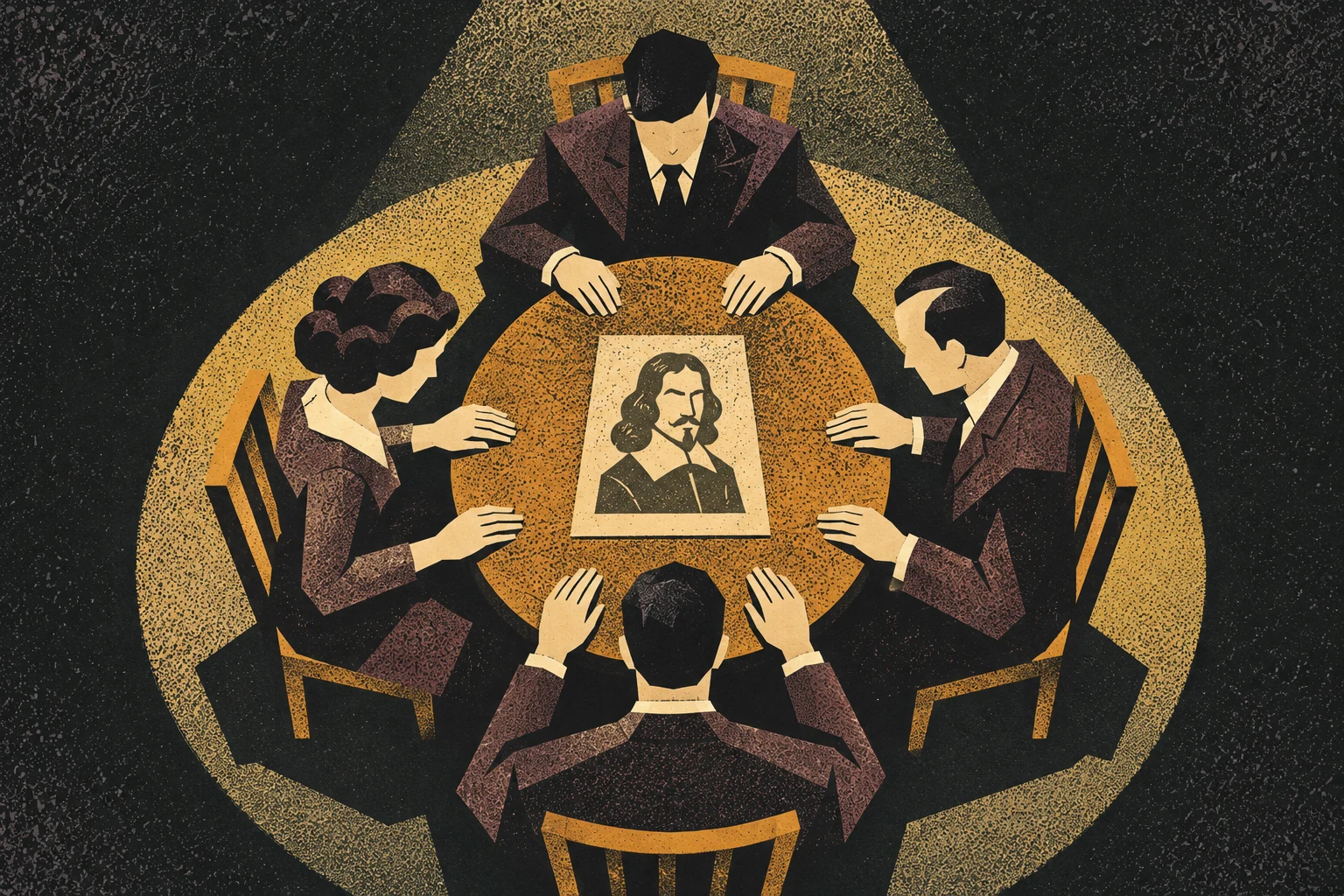
They invented a dead man, gave him a history and asked him to answer. When the table began to knock, the Toronto group faced an awkward question: who, or what, was responding?1
A ghost with an author
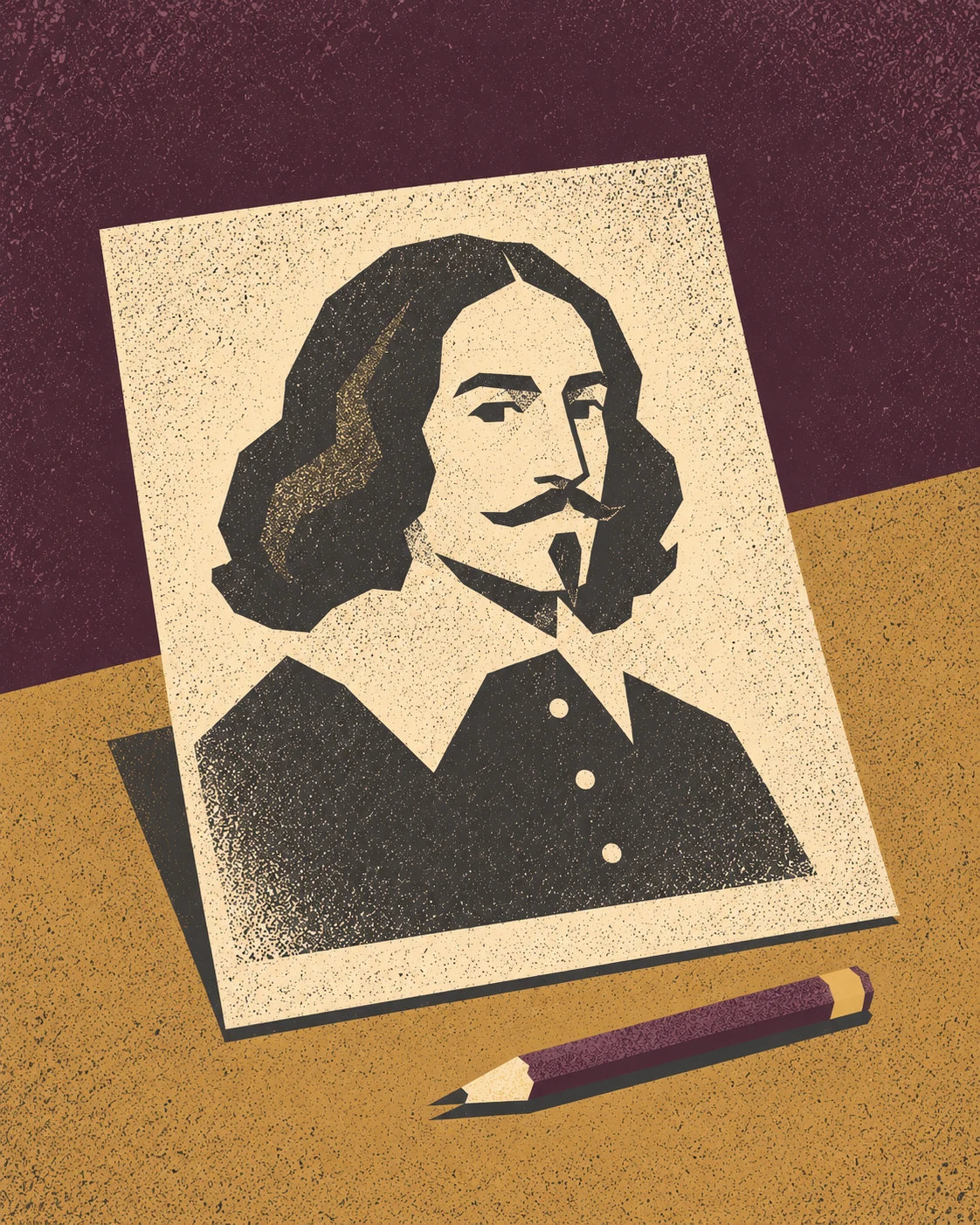
Philip was not a missing person whose identity the investigators hoped to recover. His existence began as an agreed fiction. In September 1972, members of the Toronto Society for Psychical Research started meeting to see whether sustained concentration could produce an apparition. Eight regular participants developed an imaginary seventeenth-century Englishman, with a portrait and an unhappy personal history. Their first report appeared in January 1974.1
The distinction was deliberate. A séance organised around a real dead person leaves room for arguments about obscure biographical information or facts supposedly unknown to the medium. Here the participants supplied the personality themselves. If something answered in character, the answer could not straightforwardly authenticate the return of that particular historical man. There had been no such man to return.1
The original aim was not achieved. After months of meditation, no agreed apparition appeared. The group changed its procedure, adopting singing, joking and encouragement rather than solemn concentration. The report describes sensations in the table, audible raps and, later, movement. Participants addressed the table as Philip, using one knock for yes and two for no. Their invented character had apparently acquired a means of answering.1
That sequence contains several different questions. Did the meetings happen? Did participants hear knocks and see a table move? Did they correctly identify what caused those effects? Did any effect require a personality beyond the people present? Evidence sufficient for one question may leave the next unanswered. A report of a responsive table cannot establish all four propositions merely by giving the communicator a name.
The experimenters knew this was a strange case. They were not offering a newly discovered ghost biography. Their proposal was more disruptive: perhaps the personality at a séance could come from the living, even if the associated movements involved something they considered paranormal. That interpretation challenged a simple spirit explanation while leaving another extraordinary claim, psychokinesis, on the table.
The surviving contemporary reports make it possible to examine that distinction. They also prevent a misleading version of the story in which investigators begin by finding a haunted room and only later discover the identity of its occupant. Philip's identity preceded the phenomena. The name, character and expected answers were part of the conditions under which the group sought a result.
What a moving table proves
A later participant account describes a professional film made under Ian Brims's direction, with financing arranged by society member Bruce Raymond. It combined a recreation of the experiment's development with demonstrations of reported effects. Iris Owen described bright filming lights and further television appearances. These were attempts to make the case visible outside the original circle, not merely another private recollection.2
But there is a difference between recording a movement and recording its cause. An image may show a table tilted or displaced while leaving the forces applied to it unknown. Hands resting lightly on the top remain a physical connection. A view that includes faces and fingers may omit feet, the underside, a table edge or the distribution of pressure. Brightness answers a question about illumination, not every question about experimental control.
The same distinction applies to witnesses. A surprised observer can reliably report being surprised. An observer can also identify a sound or a movement without identifying its mechanism. Inviting somebody who began sceptically adds a perspective, but their change of mind is not an instrument measuring force. The useful question is what they could inspect and what alternative actions their position allowed them to exclude.
The lift outside the film
Owen's 1975 continuation contains an important qualification about levitation. She reported that, after the film-making had ended, a private session produced a brief complete lift. The account says an adequate photograph was not obtained. It therefore does not make that particular alleged lift part of the professional film's visual evidence. A retelling that joins the filmed demonstrations and the private claim creates a stronger record than the source supplies.2
Does this establish that somebody cheated? It does not. Inadequate exclusion of an ordinary mechanism is different from observing deception. Several possibilities remain: deliberate action, unwitting action, a mistaken interpretation of what occurred or an effect the observers could not explain. These should not be compressed into a choice between a genuine ghost and a proven fraud.
What would make the footage more informative? An uninterrupted view of the whole table, calibrated measurements and clearly documented contact would allow more precise questions. Edited demonstration footage may still be historically valuable, showing how the case was presented and what participants believed. Its value as a record of the group does not automatically give it the power to exclude every ordinary source of movement.
Faraday's earlier investigation
The central difficulty was already familiar in the nineteenth century. During the table-turning excitement of 1853, Michael Faraday investigated claims that tables moved under the resting hands of people who denied pushing them. Proposed explanations ranged from electricity and magnetism to an unknown physical agency. Faraday designed his tests around a narrower question: did movement begin in the table or in the hands?5
He first checked whether placing different materials between the hands and tabletop prevented the effect. It did not. This mattered because he could then use intervening materials in an apparatus without the participants rejecting them as something that necessarily blocked the supposed force. His investigation was not simply a declaration that table-turning was impossible. It attempted to separate competing explanations under conditions acceptable to the people producing the effect.5
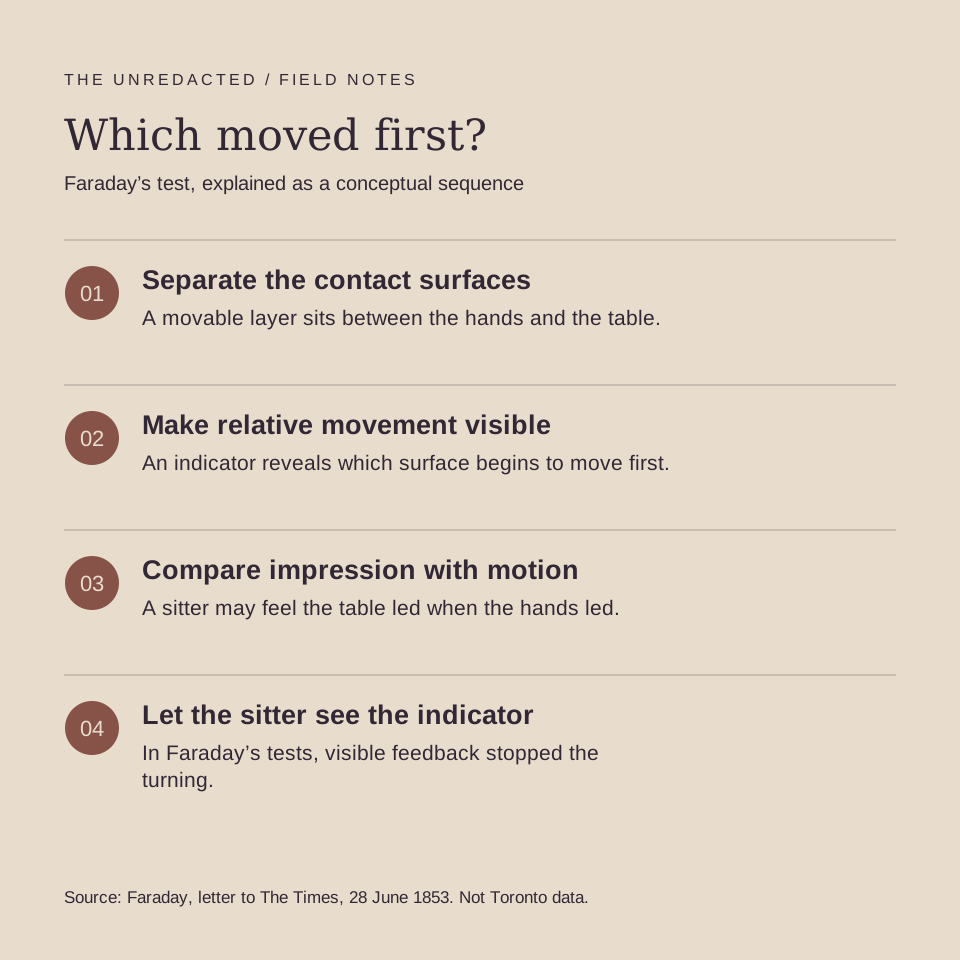
Faraday arranged a movable surface and an indicator so that relative movement between the hands and the table became visible. If the table led, the indicator would respond one way; if the hands moved first, it would respond the other way. The arrangement transformed a participant's impression of following the table into a physical sequence that could be observed. It tested the order of events instead of asking the sitter to judge their own intentions.5
Faraday dated his letter to The Times at the Royal Institution on 28 June 1853. His reported results favoured unwitting muscular action. With the indicator concealed or ignored, the hands exerted force in the direction the participants wanted the table to travel. The participants believed they were pressing downwards rather than pushing sideways. When they watched the indicator, the movements ceased in his tests. Feedback showed them an action of which they had not previously been aware.5
The implication was uncomfortable but quite specific. A person could sincerely deny pushing while nevertheless helping to move the object. Intention, awareness and muscular activity were not identical. Faraday's mechanism did not require a conspiratorial agreement among everyone in the circle. Several people trying to follow the same movement could contribute to it while experiencing the result as something originating elsewhere.5
In that setting, sincerity was compatible with error. An investigator did not have to decide that every participant was dishonest before testing the contact between hands and furniture. Conversely, an assurance that everybody was honest could not rule out the mechanism. Faraday replaced that argument about character with an arrangement that showed what the hands were doing.5
His experiment did not take place in Toronto, and it cannot retrospectively establish the cause of every sound or movement attributed to Philip. Its relevance is methodological. It demonstrates a way in which a table can move contrary to its sitters' sincere account of their own actions. That makes ordinary contact a question to investigate, rather than something eliminated because the participants say they were not deliberately pushing.
Nor does the explanation turn the participants' experience into nothing. If a person expects a response, feels an object begin to move and joins others in following it, the experience can be powerful. The historical question is why the event was interpreted as an external agency. The experimental question is whether ordinary force can be excluded. Neither requires dismissing the existence of the meeting or the strength of the impression it left.

The sound beneath the table
The Toronto investigators did attempt to move beyond impressions. In a 1975 paper, Joel Whitton described recordings made with a microphone attached beneath a card table. He examined seven raps selected from sessions in which the group verbally identified a sound as a response. Comparison sounds included deliberate taps, kicks and other forms of contact with the table. He reported differences in how the recorded sounds developed and faded.3
Whitton also recorded limits in his equipment description: the overall recording system's frequency response and gain characteristics were unknown. The analysis concerned the broad shape of the sounds, rather than a complete identification of their physical source. The paper proposed that the unusual traces reflected psychokinesis. That proposed explanation went beyond observing a difference between the selected samples and the particular comparison noises.3
The selection procedure matters. A rap entered the unusual category because the group had recognised it as an answer. The subsequent analysis therefore did not independently establish which noises were communicative. It compared sounds already interpreted that way with sounds deliberately produced for comparison. That can reveal a pattern, but it cannot by itself demonstrate that the category was defined without expectation influencing the selection.
A sound recorded through a structure depends on how that structure is excited and how the recording system responds. Changing the point of contact, the support of the table or the microphone's coupling can change a recording. Those are experimental considerations, not a reconstruction proving that any particular sitter made a particular rap. They identify conditions a proposed paranormal distinction would need to survive.
A second acoustic test
Whitton published a further acoustic study in 1976, including recordings associated with a suspended steel plate and earlier material from another group. He described more than one characteristic sound shape and interpreted the comparison as supporting the reality of unusual raps. The additional study broadened his account beyond a single wooden table, while retaining the problem of connecting a recorded waveform to its cause.4
A trace with an unusual appearance is a starting point for investigation. To identify a new physical process, the comparison needs to establish that known ways of producing and recording sound cannot account for the result. The number of alternative mechanisms actually tested matters more than how unfamiliar the trace looks to a reader. A different waveform does not arrive with an explanation attached.
The acoustic work is therefore worth preserving in the case. It supplies dates, methods, samples and propositions that can be examined. It should neither disappear behind the more entertaining ghost story nor be promoted into a laboratory confirmation of a spirit. It records an investigator trying to discriminate between sounds, with an interpretation that remains dependent on the adequacy of the discrimination.
An answer without knowledge
The group's later work produced another revealing test. In her 1976 report, Owen described a visit to Kent State University in March 1975. Among the experiments was a choice between ten containers, one holding a steel ball and the others green glass marbles. Participants recorded individual choices; Philip was also asked to choose through raps. Owen reported that the group did poorly at locating the steel ball.6
She nevertheless considered a different pattern interesting: Philip's choice reportedly followed the participants' majority choice. That observation prompted a claim about the group's collective mental activity. It did not demonstrate successful identification of the hidden target. The distinction is crucial. Agreement about an answer, even if intriguing, is not the same result as obtaining the answer from information nobody in the group possessed.6
This is one of the case's most useful complications. An apparently responsive communicator may reproduce what the circle expects without supplying reliable knowledge about the world. A historical personality can sound convincing because everybody knows the outline of the character. A concealed object presents a different task. Its location cannot be established simply by maintaining the personality's voice or repeating a shared preference.
Suppose several sitters agree that Philip would answer yes to a question about his fictional life. A yes-like response would be consistent with that agreement, but would not identify the route by which the response arose. Asking a question with an independently recorded answer could make the result more informative. It would still require safeguards against ordinary information transfer and decisions about scoring made before the outcome was known.
The Toronto programme also changed over time. A 1977 report described the original participants continuing to meet, with visitors and further demonstrations entering the record. This was a sustained practice rather than one isolated night. That continuity helps explain why later accounts differ in apparatus and phenomena. A result reported in a later phase should not silently be inserted into the first experiment as if the procedures had remained identical.7
Changes are not necessarily a defect. Investigators often alter procedures in response to what they observe. But each alteration changes the evidential question. A claim about a card table with hands on its surface differs from a claim about sound in another object. Results need to be attached to their own conditions, not pooled into a single escalating list in which every success appears to validate every other one.
Did imagination move matter?
The experiment's proponents had an explanation that did not require Philip to have lived. The personality could be an invention while the physical effects arose from the living participants' collective mental activity. In that account, the fictional character organised attention, expectations and emotion. Psychokinesis supplied the proposed link between those mental conditions and an object in the room.16
Could that be what happened? Establishing that the group imagined a personality does not establish the additional physical claim. Ordinary muscular action, deliberate intervention and errors in observation remain relevant wherever the conditions permit them. The hypothesis has to account for an effect demonstrably beyond those alternatives. Calling the character imaginary removes one explanation of his identity; it does not automatically validate another explanation of the table's behaviour.
British psychologist Kenneth Batcheldor had explored related sitter-group methods before the Toronto work. A later SPR account describes his interest in relaxed conditions, group composition and the possibility that scrutiny inhibited results. It also records his awareness of unwitting muscular action. The relationship helps explain the Toronto group's procedural change. It does not make experiments conducted by different people interchangeable evidence for a single mechanism.8
An experimental tension follows. Supporters may consider relaxation and confidence necessary to produce an effect; an independent examiner may require restrictions that alter those conditions. That tension does not prove the effect false. It does mean that the experiment needs an agreed procedure capable of both producing a result and distinguishing its cause. A result that disappears whenever an alternative mechanism is properly tested remains difficult to interpret.
Repeating a séance format can reproduce ordinary mechanisms as well as extraordinary ones. A second group getting a table to move would demonstrate that the experience was not unique to one circle. It would establish more if the new group also met stronger controls and obtained an outcome that those controls were designed to discriminate. Repetition without that distinction can preserve the same uncertainty across many sittings.
The surviving reports are particularly valuable where they record unsuccessful efforts or unexpected answers. Those details resist a simplified success story. They allow the reader to ask whether the proposed communicator delivered information, whether a physical outcome was measured and whether the result supported the interpretation attached to it. A sympathetic account can contain evidence that complicates its own conclusion.

A result that changes with its audience
Owen's 1977 account describes further public demonstrations and visits to the group, alongside its continuing private meetings. It presents the participants as practising and developing a shared activity over years. That history is relevant to any claim that they simply stumbled into one extraordinary event. They were learning how to conduct sessions, how to recognise a response and how to explain the work to other people.7
Public demonstration changes the setting without necessarily settling the mechanism. An audience supplies more witnesses, but it also directs attention towards what the presentation makes visible. A clearly audible knock can be heard by many people at once while its physical origin remains obscured. More agreement about the occurrence does not automatically mean more independent information about its cause.
The useful comparison is between particular conditions and particular outcomes. Which contacts remained? What was measured continuously? Which unsuccessful attempts were retained? These questions can be asked of a sympathetic report without assuming that the authors intended to mislead. They determine how much a reader can responsibly conclude from the records that survive.
Or did something else answer?
There was a more traditional supernatural alternative. Owen's 1976 continuation mentions correspondence from spiritualists who warned that actual spirits might be using the invented personalities. On that interpretation, Philip's fictional biography did not prevent a separate intelligence from impersonating him. Owen rejected the need for that explanation and presented the experiment as an alternative to communication with the dead.6
The impersonation proposal solves a narrative problem: how could a nonexistent man answer? But it does so by adding an agent whose identity is not independently established. The same responses that fit the group's imagination can be redescribed as a spirit adopting the group's fiction. Without a test that distinguishes those accounts, the added explanation can accommodate the observation while supplying no new way to verify itself.
That does not mean the experiment disproved survival after death. It did not test every form of alleged communication, and Philip was designed to be fictional. Its narrower challenge is to the assumption that a coherent séance personality must authenticate a real deceased individual. Coherence can come from a story shared by the living. Whether the associated effects were paranormal requires a separate evidential argument.
As of the sources checked on 6 November 2026, these reports document a long-running experiment, remarkable experiences claimed by its participants and attempts to measure selected effects. They do not establish that a spirit was created or that psychokinesis caused the movements. Philip's most unsettling feature remains firmly within the record: the people receiving the answers already knew the man answering them had been invented.
Follow the evidence
Sources & further reading
- Generation of Paranormal Physical Phenomena in connection with an Imaginary Communicator Iris M. Owen and Margaret H. Sparrow · 1974-01 · Accessed 2026-11-06
- Philip’s Story Continued Iris M. Owen · 1975-04 · Accessed 2026-11-06
- Qualitative Time-domain Analysis of Acoustic Envelopes of Psychokinetic Table Rappings Joel L. Whitton · 1975-04 · Accessed 2026-11-06
- Paramorphic Table Rappings: Acoustic Analysis Joel L. Whitton · 1976-06 · Accessed 2026-11-06
- On Table-turning: letter to The Times Michael Faraday · 1853-06-28 · Accessed 2026-11-06
- Continuation of the Philip Experiment Iris M. Owen · 1976-06 · Accessed 2026-11-06
- Philip’s Fourth Year Iris M. Owen · 1977 · Accessed 2026-11-06
- Kenneth J Batcheldor Psi Encyclopedia / Society for Psychical Research · Accessed 2026-11-06