
In April 2019, a radio telescope listening towards Proxima Centauri recorded a narrow signal that survived the usual interference checks. Could it be alien technology? The investigation eventually pointed to Earth, but finding out why took months.3
The line in the data
The observation came from Murriyang, the Parkes radio telescope in New South Wales. Its 64-metre dish stands on a tower north of the town, on Wiradjuri Country. Completed in 1961, it had spent decades gathering radio waves long before this particular signal appeared. Nothing about the instrument made an unexplained detection automatically extraterrestrial. Its sensitivity also meant it could collect evidence of technologies much closer to home.4
The target made the observation particularly suggestive. Proxima Centauri is the nearest star to the Sun, a faint red dwarf just over four light-years away. In 2016, astronomers announced evidence for a planet, Proxima b, orbiting it roughly every eleven days. Its position allowed the possibility of liquid water under suitable conditions. That did not establish an ocean, an atmosphere or life. It did make the system a place where a search for life had a specific astronomical target.5
The 2019 observations were part of a campaign studying stellar flares. The same recordings could also be searched for narrow signals of the kind that a transmitter might produce. A dataset made for one purpose had become evidence for another. There was no reported moment in which a person at the dish heard a voice from the star. The clue emerged later, when the recorded radio data were processed and examined.10
Shane Smith, a Breakthrough Listen undergraduate researcher, identified the feature in 2020. His mentor, Danny Price, shared a plot with the group. Sofia Sheikh volunteered to lead the investigation. In her first-person account, Sheikh described a trace that her colleagues could not immediately explain. They had no decoded communication or identified sender.6
The initial search had produced more than four million detections across its observing data. Those were signals above the search threshold, not four million possible civilisations. Most could be rejected as interference. Smith and his colleagues reported that 5,160 events survived a directional selection, after which visual inspection and further filtering left one particularly interesting case. Its informal name was BLC1, short for Breakthrough Listen Candidate 1.1
Even the word candidate needed care. The researchers preferred signal of interest. It identified something worth examining, without claiming that the difficult work had already been done. A genuine transmission from another civilisation would have to survive explanations involving the telescope, terrestrial electronics and human spacecraft. The label marked the beginning of those tests, not their result.1
The first published papers ultimately attributed BLC1 to human interference. That finding does not make the original trace less real. Something had entered the receiving system and left a measurable pattern. The question was how an earthly signal could pass checks designed to distinguish it from something in the sky. Solving that problem required examining details that the first automated search had not resolved.7

A signal that knew where to appear
The signal lay near 982 megahertz. More important than the frequency itself was its narrowness: its measured width was less than four hertz. Its frequency also changed gradually. On a plot showing frequency against time, that movement appeared as a slanting trace. Those characteristics made an engineered source a serious possibility. They did not tell the researchers whether the engineering had been done by humans.2
A radio receiver can find artificial signals without discovering extraterrestrial intelligence. In a February 2021 interview, before the final papers appeared, Breakthrough Listen principal investigator Andrew Siemion emphasised that distinction. The problem was separating signals produced by our technology from those that might come from another civilisation. At that stage, he already considered a human source overwhelmingly likely, while acknowledging that the particular origin had not been established.12
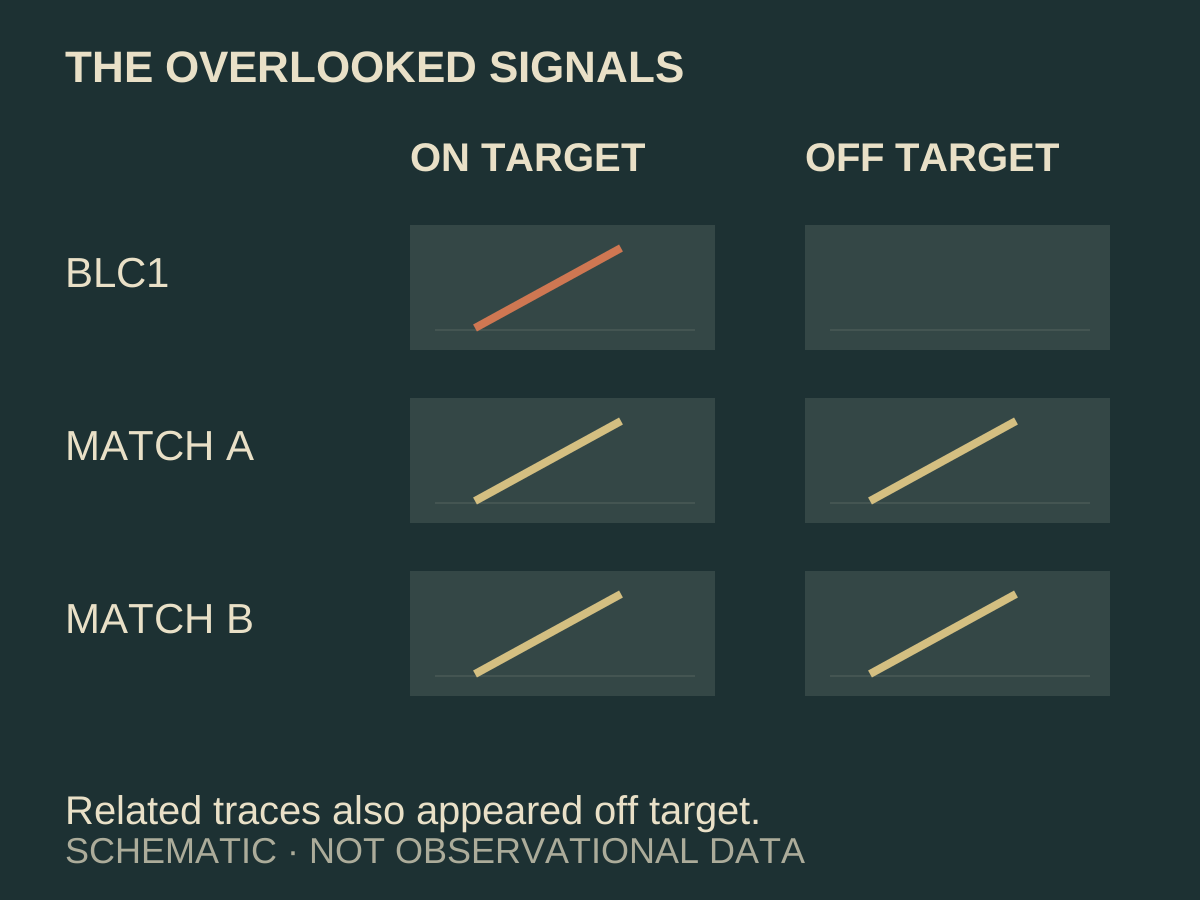
The telescope's movements supplied a more demanding test. A signal genuinely arriving from the target direction should become much fainter when the dish points elsewhere. The observers therefore alternated between the star and reference positions. Researchers call these on-source and off-source observations. Interference nearby might appear in both, allowing it to be rejected. BLC1 seemed to appear in the observations towards Proxima while disappearing from the comparison pointings.9
That apparent preference for the star distinguished it from routine interference. It also created the possibility of a misleading coincidence. Pointing direction was not the only thing changing. Time passed between one observation and the next. If an interfering source changed strength or switched on and off during the sequence, it could imitate the pattern expected from a fixed source in the sky. The telescope's movements would then seem to locate something they had not actually located.
The observation also had to be described accurately. The detailed analysis recorded detections over a span of about five hours, including five half-hour target observations. It was not a continuous five-hour message. Nor did a narrow trace contain a statement of origin. The pattern told investigators where to look in the data. Attaching a planet, a transmitter or an intention to it required additional evidence.2
Reading the trace: a signal is measured radio energy; a source is what produced it; a message contains information that can be interpreted. BLC1 supplied a signal. Neither an alien source nor a message had been established.
Why did that distinction matter? A person looking at a clean line on a plot can easily imagine a deliberate beacon. A beacon might indeed be narrow. So might an unintended emission from ordinary electronics. A successful test would have to discriminate between those possibilities, rather than merely show that the trace resembled something the search had been designed to notice.
What else could make it?
The simplest general explanation was human radio interference. The difficulty was identifying a form of it that could behave like BLC1. During the investigation, Sheikh and her colleagues checked possible transmitters, local circumstances and the functioning of the equipment. Her account describes looking at instrument temperatures, telescope logs, nearby activity and whether the pointing direction coincided with a building. None of those initial checks supplied a straightforward match.6
The absence of a match made the signal unusual, but did not locate it at Proxima. A list of known transmitters is a useful starting point, not a complete inventory of everything that electronics can emit. A device can produce an unintended signal as well as the one it was designed to transmit. Finding nothing licensed at a particular frequency would not exclude leakage, mixing or a malfunction.
Could the drift have come from something moving? Relative motion can change the frequency received, making aircraft, satellites and human spacecraft possibilities to examine. The verification framework tests drift alongside duration and plausible motion. A changing frequency alone cannot establish an interstellar distance.9

The electronic alternative
There was another possibility. An electronic circuit can change its output without physically travelling along the route implied by a simple motion model. An oscillator's frequency can vary as its operating conditions change. Consequently, eliminating a particular moving transmitter would not eliminate electronics as a class of explanation. The investigation had to consider how a signal was generated, as well as where an object might have been.
The alternative was more consequential: an engineered source beyond Earth. The observed direction made Proxima an obvious candidate to consider, but a telescope pointing is not an identification of a planet. The initial pattern would need to hold up across further observations and survive comparison with other signals. An alien explanation had an opportunity to be tested. It had not earned priority simply because the most familiar earthly explanation was proving hard to pin down.
In the contemporary ICRAR account, Price summarised what had made the event worth investigating:
“The signal passed our data quality checks and interference filters”8
Passing those checks justified more work. It did not guarantee that the checks could reject every unusual form of interference. A filter is designed around characteristics that researchers know how to recognise. A previously unfamiliar failure can get through, especially when the search examines a very large number of signals. The decisive clue would come from looking beyond the one trace that had survived.
The signals that had been thrown away
Sheikh widened the search. Instead of asking only whether BLC1 looked unusual, the team looked for other signals with matching behaviour. These comparisons included records from other dates and other parts of the receiver's frequency range. A signal that seemed unique within one carefully selected plot might belong to a family that became visible only when the selection was relaxed.6
The search found dozens of lookalikes. The crucial difference was that these other signals also appeared when the telescope was looking away from its target. Their behaviour identified them as interference, and their resemblance to BLC1 connected the interesting trace with something already known to be local. The argument had become stronger than a general expectation that most strange detections would have human causes.8
Frequency spacing added another connection. The researchers found relationships consistent with clock frequencies used in electronics. Such clocks provide regular timing inside devices. If different signals interact in a circuit, the resulting output can contain additional frequencies. That process, intermodulation, offered a way for apparently separate traces to belong to one interference problem. It also explained why looking only near the original frequency had been insufficient.8
Think of two marks on separate sheets that turn out to share the same spacing, slope and small irregularities. Neither is especially revealing in isolation. Together, they can indicate a common process. The corresponding test here was numerical, using recorded radio measurements rather than the appearance of a drawing. A persuasive explanation had to connect the traces through their behaviour, not merely note that they all looked roughly diagonal.
The overlooked material mattered because the first search had done part of its job correctly. It had discarded signals that appeared in off-target observations. Those rejected signals were less promising as alien candidates, but more useful as comparisons. Keeping only the survivor would have removed the evidence needed to understand it. The seemingly uninteresting interference provided the context in which the apparently exceptional detection could be explained.
There was still a limit to the result. The team did not identify a particular appliance and reproduce BLC1 by switching it on. Its published announcement left the specific physical source unidentified. That gap is narrower than the original uncertainty. Evidence connecting a signal to human electronics does not become neutral evidence between Earth and another star merely because the offending device has not been found.7
The distinction explains why the conclusion can be strong without being a complete reconstruction. Investigators can establish a mechanism or a source class while lacking a street address or serial number. Finding the device would improve the account and might reveal exactly how the emissions interacted. Its absence does not remove the family of related signals or their observed behaviour away from Proxima.
Could it still have been a beacon?
A deliberately transmitted signal remained an important hypothesis to test. It could account for narrowness and might be compatible with a changing frequency. A distant transmitter might operate intermittently. The possibility could therefore survive the mere observation that a signal was artificial or did not repeat immediately. It faced a more specific problem once BLC1 was connected with lookalikes characteristic of earthly interference.
An alien explanation would now have to explain the whole pattern. It would need to account for the relationships among frequencies and the similar signals appearing away from the target, rather than treating BLC1 as if those comparisons had never been made. It is possible to suggest that another civilisation uses clocks or multiple frequencies. Suggesting a capability does not establish that it produced the measurements in this case.
The proximity of the star also prompted a different argument. In January 2021, Amir Siraj and Abraham Loeb published a statistical case against an inhabited neighbouring system supplying the signal. Their calculation used a Copernican framework, in which Earth does not occupy a privileged situation. This was an argument about prior expectations under a model, not a physical identification of the transmitter. It should not be presented as the experiment that found BLC1's source.11
That distinction prevents two different kinds of evidence being confused. A population model can make an explanation seem improbable before a signal is examined. A set of measurements can show that an individual signal has characteristics of local interference. The latter addresses this event directly. The two can point in the same direction without being interchangeable, and a model's assumptions remain relevant even when its conclusion sounds decisive.
There is also a difference between looking for an emission and reading a communication. BLC1 did not supply an authenticated greeting, a decoded mathematical sequence or evidence of somebody trying to reach Earth. None is required for the initial detection of distant technology. Their absence simply means that the account must remain about the recorded signal. Describing it as an alien message adds content that the observation did not provide.
The extraordinary explanation made the investigation worthwhile, but it could not be protected from unfavourable tests. If every resemblance to local interference were treated as an alien technique designed to resemble local interference, the proposal would cease to distinguish one account from another. A useful alternative needs some evidence that could favour it over the ordinary mechanism, and some possible observation that could count against it.
The telescope went back
Researchers returned to Proxima with the same instrument. Their follow-up programme covered observations in November 2020, January 2021 and an anniversary campaign in April and May 2021. A separate paper reported 39 hours of reobservation without a redetection of BLC1. Some follow-up sequences changed the balance between target and comparison pointings; the anniversary campaign also revisited the original observing pattern.10
This was more informative than taking a quick second look and finding nothing. Reobservation let the team test whether the original appearance depended on a particular sequence or returned at another time. Altering aspects of a test can expose a pattern tied to the observing procedure. Repeating the original circumstances can test whether a phenomenon reappears under conditions associated with its first detection.
The absence of a repeat was not, by itself, proof of a human transmitter. A distant source could be intermittent or no longer operating. The follow-up result mattered in combination with the other evidence: the related interference, the electronic relationships and the failure to establish a convincing astronomical origin. Those are different tests. Their conclusions should be considered together rather than allowing any single result to carry the whole claim.

Looking in another light
Could a different kind of light supply an independent clue? A separate 2021 study searched 107 archived optical spectra of Proxima, covering observations made between 2004 and 2019. These included 29 observations from March to July 2019, around the period in which Parkes recorded BLC1. The author reported no evidence of technological signals from Proxima in those spectra. The search concerned possible laser emission rather than another reception of the radio trace. It was a different investigation with its own limits, not a direct replication of the Parkes observation.15
An optical non-detection cannot settle every radio hypothesis. A civilisation using a radio transmitter would not necessarily operate a laser aimed at Earth, and archived spectra sample particular moments rather than every instant. The value of such a search is that it asks another question with other evidence. Had it found a convincing optical source at Proxima, that would have required investigation on its own terms. Its result supplied no such corroboration, while demonstrating why searches at different wavelengths should be described separately rather than combined into a blanket claim that the system had been completely examined.
The broader verification procedure also calls for observations with other telescopes when a signal survives the earlier checks. Instruments at different locations and with different designs can help separate a phenomenon in the sky from one local to a receiving site. BLC1 did not emerge from that process as a confirmed interstellar source. It became an example of how a promising detection can fail the larger investigation.9
A public archive and published methods made that finding more useful than a brief announcement that the signal was not alien. Other researchers could inspect the account, question the choices and develop different searches. Access to records is not the same as an independent reanalysis, but it supplies the material one would need. For a claim of this significance, a label attached to a plot cannot replace the observations behind it.3
A discovery that would not stay settled
The alien interpretation did not disappear from public discussion after the papers were published. In October 2024, renewed claims suggested that an announcement was approaching. Asked about those claims by IFLScience, Siemion said that no redetections or other developments had changed the conclusions of the 2021 publications. This was a response to renewed publicity, not an announcement of a newly detected beacon.13
Why could the same case return? Its most compelling original facts were still available: a nearby star, a narrow signal and an initially convincing directional pattern. Repeating those facts without the lookalikes recreates the earlier stage of the investigation. The later explanation then appears to be an opinion that can be set beside the original excitement, rather than a conclusion based on additional observations of the data.
The unidentified device provides another opening for an overextended claim. It is reasonable to ask what emitted the interference. It does not follow that failure to name that device revives every explanation once considered. A genuine challenge to the published finding would need to engage with its strongest evidence. A promised announcement, a new description of an old plot or a claim of private knowledge is not a substitute for that work.
Subsequent searches also need to be kept separate from this case. In 2023, another Breakthrough Listen project used machine learning on Green Bank data to identify signals of interest. Its public account stated that follow-up did not redetect those signals and that they had not met the criteria for bona fide candidates. A new analysis method and a new set of targets do not establish a return of BLC1.14
What remains at Proxima
As of the sources checked on 6 November 2026, the published explanation of BLC1 remains human-generated radio interference. The individual physical transmitter was not identified in the cited investigation. The 2024 response reported no development that overturned the 2021 finding. No independently verified alien transmission emerges from the material consulted for this article.713
That conclusion does not establish that Proxima's planets are uninhabited. A search covers particular times, frequencies, sensitivities and directions. It cannot exclude every possible technology or form of life. It does establish a narrower result worth preserving: the intriguing line in the Parkes data did not survive as evidence of an alien transmitter. The unanswered question is which earthly electronics produced it, rather than what an authenticated message from Proxima said.
Follow the evidence
Sources & further reading
- A radio technosignature search towards Proxima Centauri resulting in a signal of interest Shane Smith et al. · 2021-10-25 · Accessed 2026-11-06
- Analysis of the Breakthrough Listen signal of interest blc1 with a technosignature verification framework Sofia Z. Sheikh et al. · 2021-10-25 · Accessed 2026-11-06
- BLC1: Breakthrough Listen’s first signal of interest Berkeley SETI Research Center · Accessed 2026-11-06
- Parkes Observatory: heritage and telescope description CSIRO · Accessed 2026-11-06
- Planet found in habitable zone around nearest star European Southern Observatory · 2016-08-24 · Accessed 2026-11-06
- The blc1 signal is not alien, but it is a huge leap forward for SETI Sofia Z. Sheikh · 2021-10-25 · Accessed 2026-11-06
- Breakthrough Listen releases analysis of previously detected signal Breakthrough Initiatives · 2021-10-25 · Accessed 2026-11-06
- ET signal turns out to be humans phoning home International Centre for Radio Astronomy Research · 2021-10-26 · Accessed 2026-11-06
- BLC1 verification flowchart and technical overview Berkeley SETI Research Center · Accessed 2026-11-06
- No redetections of blc1 in 39 hours of reobservation campaigns of Proxima Centauri Sofia Z. Sheikh et al. · 2021-10-18 · Accessed 2026-11-06
- The Copernican principle rules out BLC1 as a technological radio signal from the Alpha Centauri system Amir Siraj and Abraham Loeb · 2021-01-11 · Accessed 2026-11-06
- Was that ET? A new radio signal and the ongoing search for alien life Glen Martin, interviewing Andrew Siemion · 2021-02-09 · Accessed 2026-11-06
- Breakthrough Listen responds to claims they have detected an alien signal James Felton, reporting Andrew Siemion’s response · 2024-10-23 · Accessed 2026-11-06
- Deep learning search for technosignatures Berkeley SETI Research Center · 2023-01-30 · Accessed 2026-11-06
- A search for optical laser emission from Proxima Centauri Geoffrey W. Marcy · 2021-02-08 · Accessed 2026-11-06