An eighteenth-century book hid its words behind stars, accented letters and an eye. When researchers broke the Copiale cipher in 2011, they uncovered a fraternity that staged operations on its recruits and kept a more awkward secret about the Freemasons.
A book without a reader
The book offered almost nothing to the uninvited reader. Across 105 pages, a careful hand had laid down roughly 75,000 characters: familiar letters mixed with Greek forms, mathematical-looking marks and larger signs that refused to behave like ordinary writing. There were paragraphs, headings and punctuation, but no visible spaces between words. A reader could recognise the apparatus of a book without being able to read a sentence. The disguise was systematic enough to survive long after the people who understood it had disappeared.12
Its few unencrypted inscriptions were disproportionately tempting. One read “Philipp 1866”. Another, near the end, read “Copiales 3”. The latter supplied the modern name. Neither was a reliable author’s signature or date of composition. The 1866 inscription was interpreted as an ownership mark. The manuscript itself belonged to an earlier century. A name that looked like an answer had become another clue requiring interpretation.1
Even the age needs care. The current project page at Stockholm University describes a manuscript from around 1730. The researchers’ historical paper instead dates the physical volume to 1760–1780 on the basis of its materials, while later analysis by historian Andreas Önnerfors places the underlying content in the 1740s. These estimates concern partly different things: paper and binding, the act of copying, and the rituals described. They do not justify assigning an exact year to the surviving book.134
The decipherment eventually changed what could be asked about it. The central question ceased to be whether the marks concealed a real language. They concealed German. The first portion supplied initiation ceremonies and rules for the Highly Enlightened Society of the Oculists, an eighteenth-century fraternity associated with Wolfenbüttel in northern Germany. Much of the remaining book described Freemasonry, including ceremonies, signs of recognition and claims about higher degrees. The cipher was solved; its historical setting still required investigation.15
The modern recovery was a collaboration between Kevin Knight, a computer scientist at the University of Southern California, and Uppsala University linguists Beáta Megyesi and Christiane Schaefer. They turned handwriting into machine-readable material, tested hypotheses and used their knowledge of language to decide which results made sense. USC’s announcement on 25 October 2011 brought the work to a wide audience. A technical account had already appeared that June.26
For anyone expecting a lost prophecy, the contents were more personal. The opening pages regulate how a stranger enters a room, who takes his hand, what he must promise and which members are allowed to know what follows. The text repeatedly worries about other fraternities. A candidate already bound to another society is questioned about his obligations. The Oculists want loyalty before instruction, and they do not assume that an existing promise elsewhere can safely be ignored.5
That detail sets the atmosphere more accurately than a claim about occult knowledge. Here is a society anxious that a recruit might enter under false pretences and take its secrets back to his previous brothers. Its response is to make him renew his allegiance in stronger terms. He may belong to overlapping worlds, but the ceremony attempts to establish which claim comes first. The book’s secrecy concerns relationships between living people as much as unreadable marks on paper.
There is another difficulty for a modern investigator. A rule book describes what an institution wanted done. It does not independently establish how often the rules were followed, who attended a particular meeting or whether a doubtful recruit slipped through. Copiale gives unusually close access to a prescribed ceremony. It is not a witness statement from every person who underwent it. That distinction becomes especially important when the text begins to describe an operation.5
Letters that meant silence
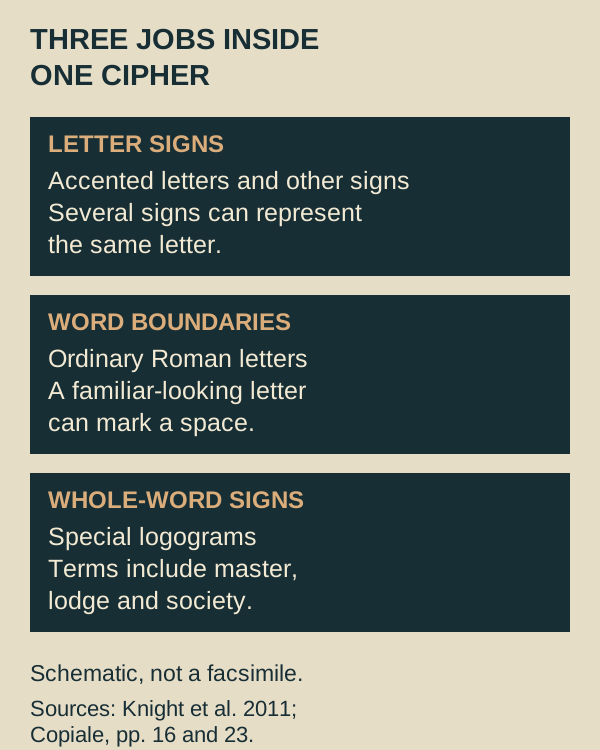
Before the ritual could be understood, the researchers had to decide which marks carried the message. Ordinary Roman letters looked like the sensible starting point. Their first approach treated the unfamiliar symbols as distractions and attacked the remaining letters. It failed. The eventual solution reversed that assumption: the ordinary, unaccented Roman letters generally marked word boundaries, while the less familiar signs carried the German text. What looked most readable was helping to conceal the reading.2
There were further complications. Several different symbols could represent the same letter, a device known as homophonic substitution. Other signs stood for combinations of letters or entire words; a colon could repeat the preceding consonant. The researchers used patterns in neighbouring characters, alongside German language knowledge, to recover the system. The result depended on both computation and interpretation. A computer could count recurring arrangements without deciding by itself what a master’s hat meant in a secret fraternity.27
An ordinary substitution puzzle offers a useful comparison. If every E becomes the same sign, its frequent appearances may betray it. Allow E to take several forms and its numerical prominence is divided between them. Yet those forms still inhabit similar surroundings, because all are replacing the same letter. The important clue may therefore be the company a sign keeps rather than its total number of appearances. This explains why a neat page can conceal a language while still preserving enough structure for an investigator to work backwards.
Encoded spaces create a related trap. A reader accustomed to gaps between words looks for separate units. In Copiale, a familiar-looking letter may be a boundary rather than part of the word on either side. Treating it as a normal letter corrupts both words. Remove it indiscriminately, however, and useful information about segmentation disappears. The distinction between a meaningless distraction and a sign performing a structural job matters. Calling every Roman letter mere rubbish understates the ingenuity of the arrangement.
The manuscript’s later instructions show that this was knowledge to be acquired, not simply an ornamental script. Prospective masters had to demonstrate that they could read and write the cipher. Instruction in that art was delayed until promotion had been agreed. The rules also forbade giving a learner an ordinary alphabet of the system. Someone could participate at a lower level without possessing the means to read the whole constitutional text.5
That is a different kind of barrier from a locked door. A person who obtained the book might still lack the skill to use it. A member taught only the signs of his own rank could not necessarily reconstruct what the next degree involved. The written system complemented the human hierarchy, distributing knowledge by stage. Its survival as an unreadable artefact was an unintended extension of the same arrangement, after the teachers and learners were gone.
The larger signs demanded a further step. These were logograms, symbols standing for words rather than individual letters. The published German transcription uses labels such as master, society and eye to make them navigable. An early transcription label resembling “lip” was only a convenient name for a shape. It did not mean the historical fraternity had worshipped a mouth. Once its context became clear, the sign was recognised as an eye and connected with the Oculists.35
A readable result must keep working beyond a promising phrase. In Copiale, the language continues through administrative rules, elaborate questions and answers, and extended accounts of other rituals. The solution opened these different kinds of passage to comparison. It also made a particularly striking first scene intelligible: a candidate is asked to read a sheet with nothing written on it. The people conducting the test know why he must fail.5
The impossible eye test
The younger doorkeeper brings the candidate in from another room and leads him before the presiding master. The preliminary questions establish whether he wishes to join, submit to the society’s rules and keep its secrets. The formal opening depends on an apparently small action: the master puts on his hat. Copiale records these movements because they tell participants when ordinary conversation has become lodge business. Nothing about the room is casual once the ceremony begins.5
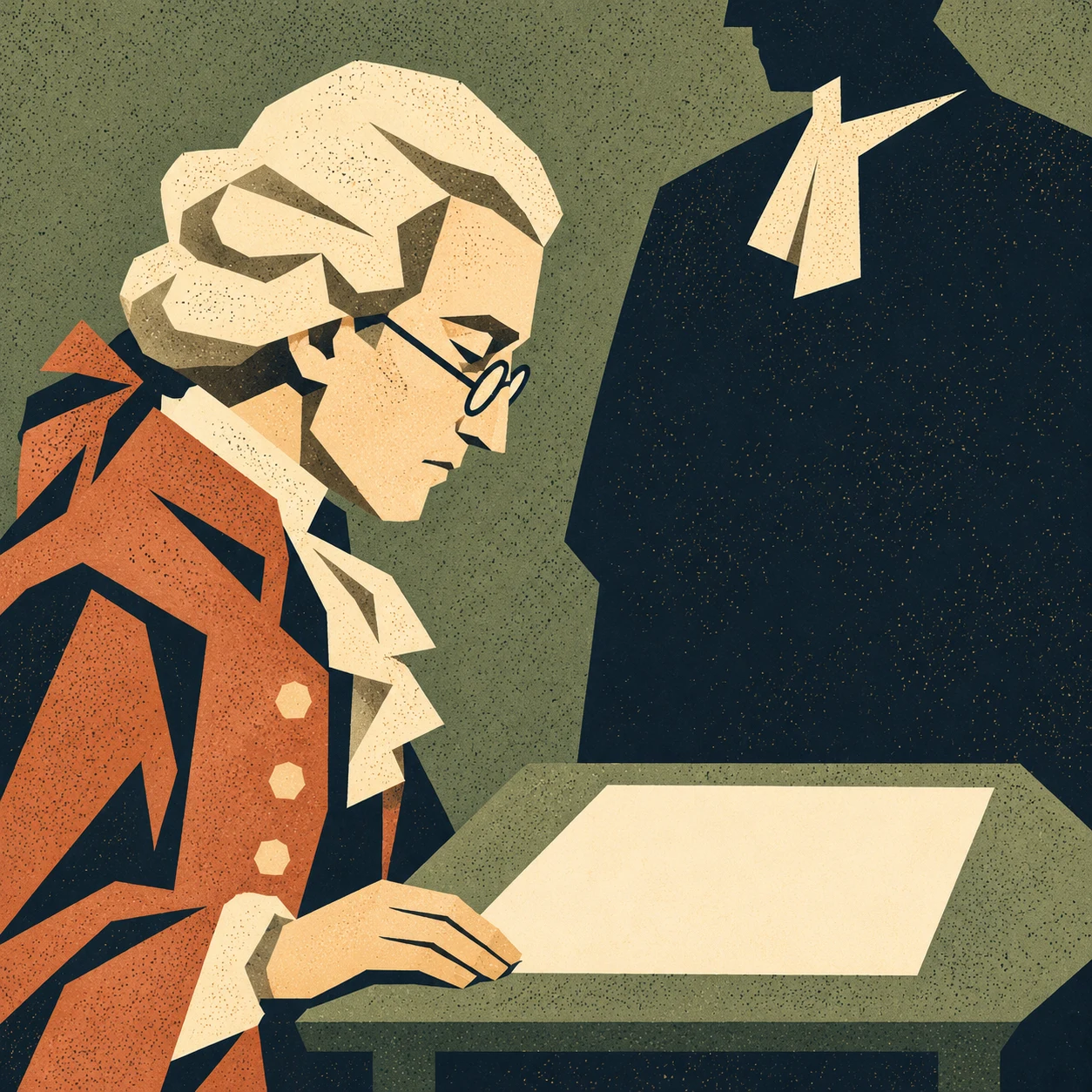
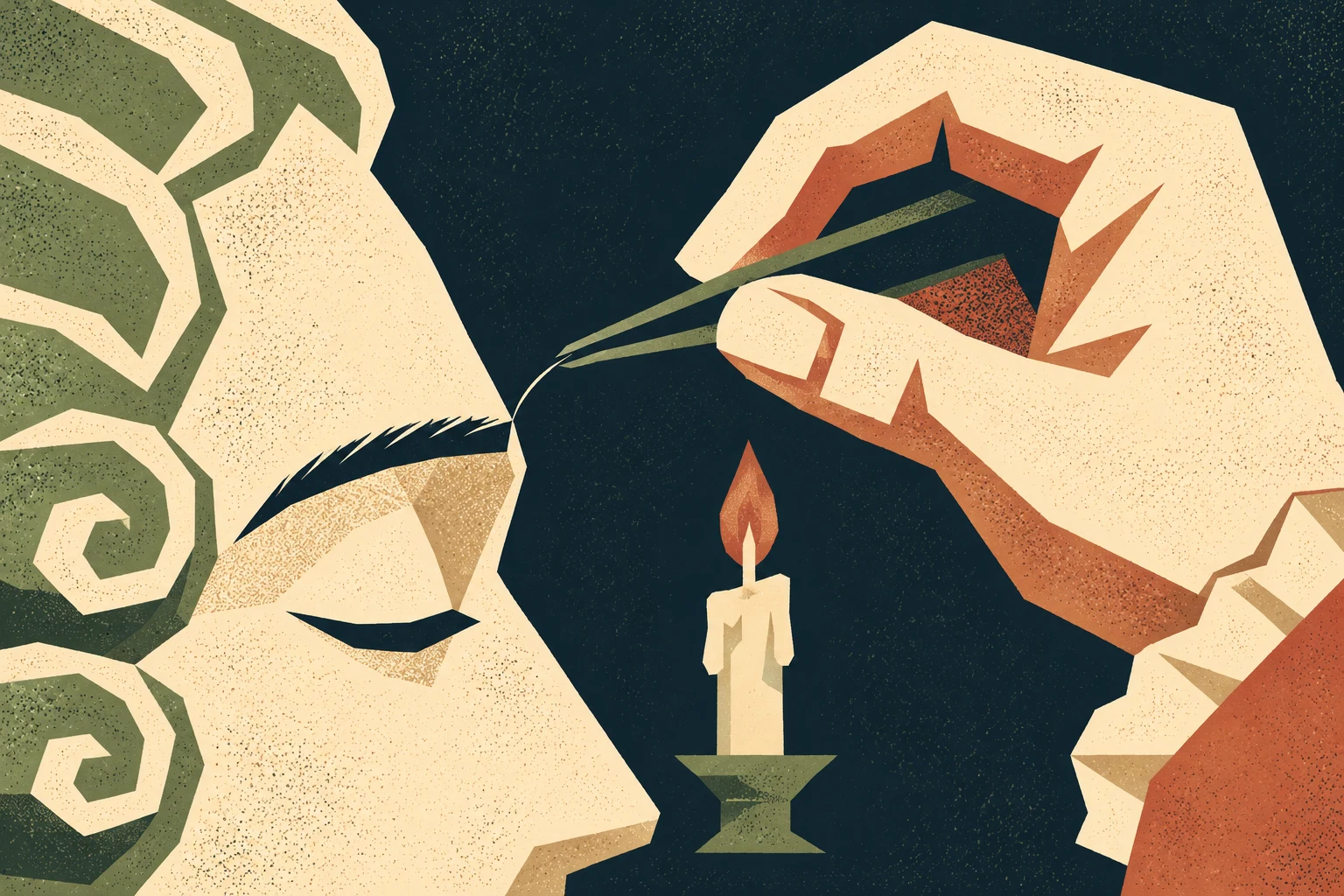
The candidate is then entrusted to the master of ceremonies. On a side table are lights, instruments, spectacles, optical apparatus, a cloth and a glass of water. He sits and examines an unwritten sheet. When he says he can see no writing, spectacles are supplied and the question is repeated. They do not help. The officiant offers comfort and hope, washes the candidate’s eyes and finally announces that an operation is necessary.5
The preparation sounds alarming if the account stops there. The next page explains what the operation actually comprises. The assembled members take up the lights and gather around. With a small pair of tweezers, the master of ceremonies plucks a hair from the candidate’s eyebrow. That concludes the procedure. The text does not prescribe cutting an eyeball, removing a lens or treating a cataract. Its measured sequence of failed remedies builds towards an ordeal far smaller than the medical language initially suggests.5
This is where the book corrects its own sensational reputation. A ceremony centred on eyes can be described as an eye operation, and early publicity emphasised ophthalmology. But the relevant passage is a staged admission ritual. Its meaning has to be sought in the transition it creates, rather than in a surgical technique it does not describe. The candidate’s sight has not been measured through a genuine reading test. An empty page has guaranteed the initial failure.5
The master warns him against dismissing the society because its ceremonies seem unserious. He is instructed to look beyond their outer form and consider what the symbolic actions mean. The scene could be comic and coercive at the same time: a group creates an impossible task, surrounds the newcomer and administers a token discomfort before explaining that he has misunderstood the surface. Copiale prescribes the words and actions. It does not record whether a particular initiate laughed, feared injury or remained unconvinced.5
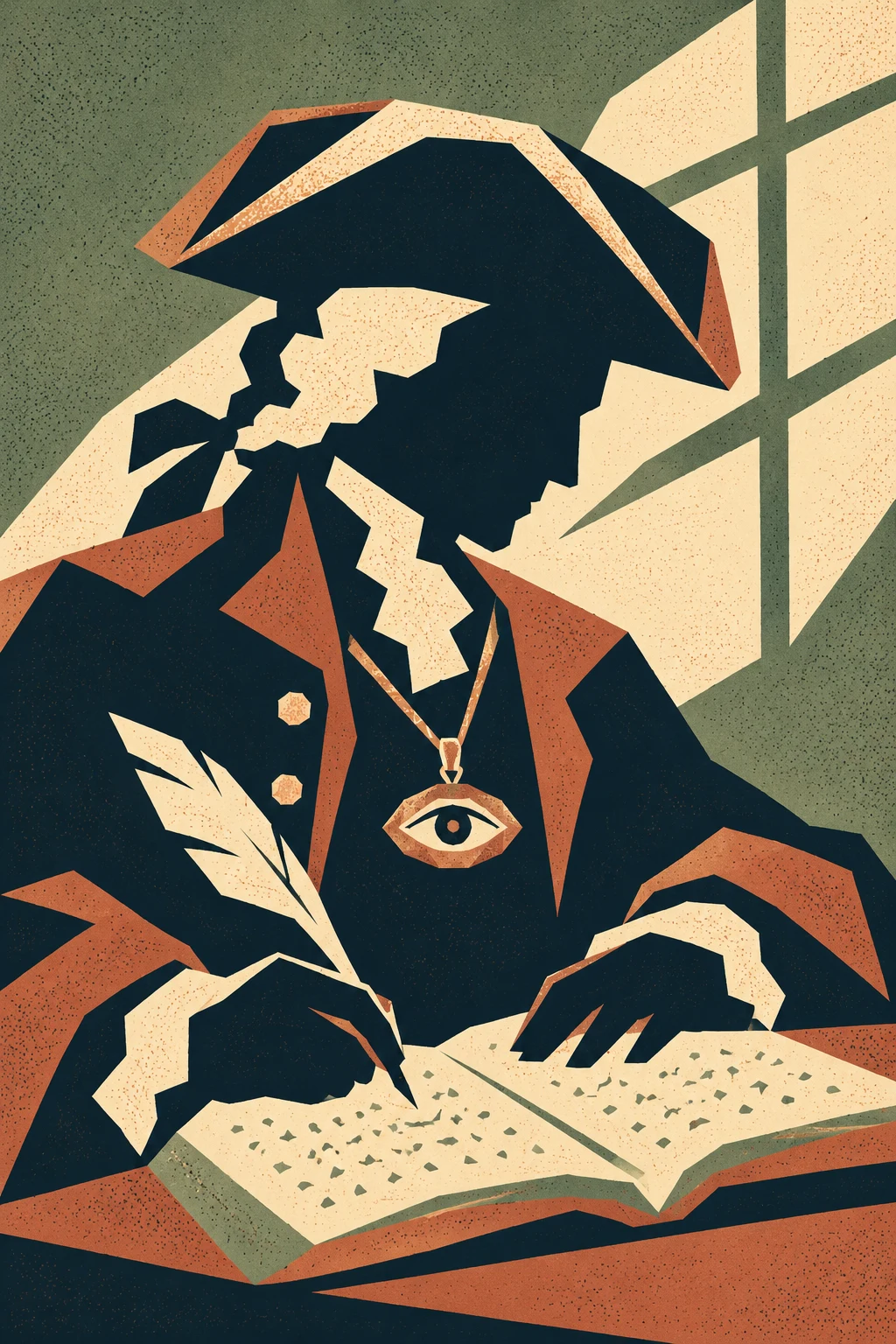
The candidate then places his right hand on the eye worn at the presiding master’s neck and repeats an obligation read by the secretary. He promises to disclose only what he is permitted to disclose and to enter no other secret fraternity without special permission. The oath extends to present and future members, whatever their nation. Its threatened punishment is public disgrace: he accepts being declared a dishonour to his sex and to the respectable world if he breaks his word.5
Only after this pledge does the blank page change. The secretary has put the apprentice’s instruction in its place. The recruit can now encounter writing where he previously found none. The effect depends on substitution, carried out by people who control the lesson. It is an unusually clear piece of ritual theatre about access to knowledge. The society does not simply claim to open eyes. It decides when there will be something available to see.5
The written teaching is not meant to become a convenient souvenir. Copiale directs that it be torn up before the lodge closes, which is signalled by removal of the master’s hat. Instruction, obligation and destruction of the temporary text belong to the same sequence. The newly admitted member leaves with information and responsibilities; the sheet that helped confer them is to disappear. The ceremony has converted an outsider into someone trusted with a limited portion of the secret.5
A gesture across the room
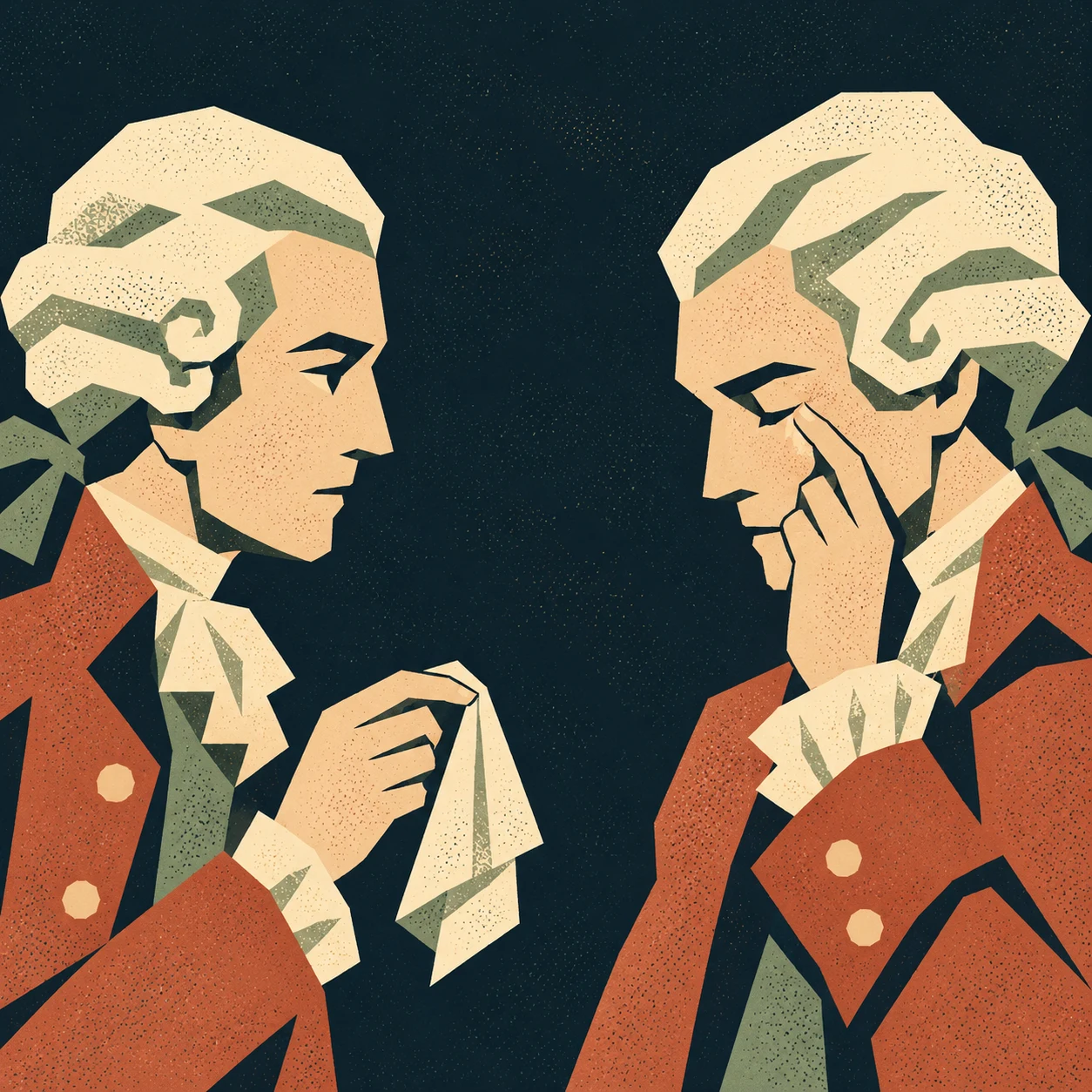
The apprentice must next learn how to recognise another member. Copiale offers actions that could disappear into ordinary behaviour. One person turns his head left and then right as though searching for something. The response uses a handkerchief and a look. Another moves one hand while keeping the other still; the answer uses the opposite hand. A pinch of tobacco taken with particular fingers of the left hand is answered by touching the left eye.5
These are paired signals rather than a universal badge. A gesture means something because it receives the prescribed answer. The instructions expressly distinguish each question from its response and allow the order of questions to vary. The exchange is also restrained: one member should not keep asking while the other supplies nothing in return. Recognition is reciprocal, with each participant expected to demonstrate some knowledge before extracting more from the person opposite.5
A single correct movement is insufficient. A brother identifying himself must be able to recount his initiation and name those who were present. That requirement adds a human check to the bodily signals. Someone who has copied a hand movement still has to supply a plausible account of admission. It also reveals a possible weakness: knowledge of the ceremony and of real members could be more useful to an intruder than possession of a picturesque emblem.5
The directions extend to mistakes in mixed company. When strangers are present and a member speaks or acts incautiously, the response is an apparently unremarkable assertion that the matter is already known. In context it functions as a warning. The book’s concern is practical concealment during social encounters, not perpetual silence behind a guarded entrance. Its members are expected to pass between lodge life and settings where others must not realise that lodge business is taking place.5
Promotion introduces more elaborate tests. For a fellow, touching the right eye is answered by a movement along the corresponding side of the neck. Questions about how long someone took to acquire his knowledge, or what time it is, can be answered through counting previously exchanged signs. The correct number depends on the conversation that has just occurred. An outsider overhearing the final answer may miss the rule producing it.5
The instructions insist on progression. A person should not be tested as a fellow before answering the apprentice’s questions correctly. Nor should he be recognised as a fellow without knowing the complete ceremony of that promotion. The document is constructing a sequence of proof, even if that proof would not meet a modern investigator’s standards. The proposed member must demonstrate the lower level before being invited to show knowledge of the higher one.5
The master’s sign moves into conversation. One participant mentions a brother named Hans. The reply introduces Anthon; the next speaker offers Nicolaus, followed by Sebastian. Each new name begins with the second letter of the preceding name. The exchange can look like ordinary talk about acquaintances while quietly establishing the participants’ command of a shared rule. The example is preserved in the decoded text, so its mechanism can be checked rather than guessed from a modern retelling.5
These provisions also show the limits of what the manuscript can tell us about daily life. It supplies scripts for secrecy, including ways to detect hesitation or conceal a warning. It cannot show how frequently two members used them successfully in a crowded room. Reconstructing that social world would require correspondence, membership records or reports of actual encounters. The rule book gives an intimate view of what the organisers feared and valued, while leaving many of the people who performed it unnamed.
Who earned the hat?
The distinction between ranks was enforced inside the society as well as outside it. An apprentice seeking advancement was questioned about his loyalty and about entering other fraternities. An unsatisfactory answer could bar him permanently from becoming a fellow. A successful candidate renewed his obligation with his hand against the master’s eye emblem and promised not to reveal a fellow’s teaching even to an apprentice. Secrecy separated neighbours in the same institution.5
At the master’s degree, the candidate’s trustworthiness was again put to the assembled members. Only if they approved did he proceed to his practical demonstration. The decisive task was to show skill in reading and writing the society’s cipher. Here the medical vocabulary gives way to a clearly specified kind of competence. Whatever else a “light hand” might suggest, the manuscript makes cipher literacy part of the test for authority.5
He received the master’s ornaments and hat, heard the explanation of the society’s seal, and was taught what the text called its true secret. Permission to make selected notes in cipher accompanied the promotion. Even then he was not simply entitled to possess every document. The rules allowed a complete copy of the secret constitution only to an authorised master with the relevant powers. An ordinary master could extract the necessary portions, and a lodge should have no more than one copy.5
The authorised figure had to produce a sealed diploma demonstrating his right to establish and close lodges, admit candidates and confer advancement. The distinction matters because a title in a ceremony is not automatically proof of institutional power. Copiale imagines authority travelling through recognised documents as well as knowledge. The diploma is meant to establish that its bearer can act for the organisation, rather than merely imitate somebody who has learned its signs.5
The constitution is especially revealing about Freemasons. They may enter the Oculists as apprentices and fellows, but the rules forbid their promotion to master. That prohibition itself is to remain hidden from them. A man could therefore be accepted into the lower ranks without being told that his previous membership permanently obstructed further advancement. The fraternity’s layered teaching protects a distinction that some of its own members are not supposed to discover.5
A master must also avoid revealing the society’s interest in the Masons, even to fellows. The awkwardness is deliberate. Members are allowed to know enough to participate while being denied the reason for a significant part of the programme. The manuscript’s own arrangements make it unsafe to speak of one uniform Oculist belief shared equally by every initiate. A person’s understanding could depend on how far he had progressed and what the organisers chose to disclose.5
Recruitment depended on another kind of claimed expertise. Fellows were instructed to examine the eyes of people they encountered and infer their dispositions, so that the lodge could obtain a character portrait when considering admission. Copiale presents that as a way of judging suitability. It supplies no demonstration that a person’s moral character can be read from his eyes. The instruction is evidence of the society’s method and confidence, not proof that its diagnostic claim worked.5
Women also enter the text. The obligation contains masculine and feminine alternatives, while the origin narrative expressly criticises the Masons for excluding women. That establishes a place for female membership in the Oculists’ stated conception of themselves. It does not identify every woman admitted, measure equality within the lodge or prove that opportunity matched the rhetoric. The surviving constitutional language is more specific than a claim that the order was exclusively male, and more limited than a complete social history.5
The secret about secrecy
The true secret begins with an account of human curiosity. People want to know something merely because it is hidden. According to the story taught to masters, a group of friends in England discussed this weakness and decided to test it. They would create a fraternity whose purpose was concealed until admission, allowing them to see how many people would bind themselves to an organisation without knowing what obligations would follow.5
“We often want to know something merely because it is kept secret.”
In this version, the founders invented signs of recognition and arranged another meeting to complete their plans. One participant missed it. By the time he returned, the others had established Freemasonry, and some did not know or remember his role in the original discussion. He declined to disclose himself. He disliked their careless choice of brothers and the exclusion of women, and went on to found the Oculists instead.5
It is a pointed origin story, not an independently verified account of the founding of Freemasonry. Its function is to give the Oculists an advantage over their rivals. Their supposed founder knows how the other institution began and understands the emptiness behind its pretensions. The Masons, meanwhile, are said to know nothing of the Oculists’ arrangements. One fraternity can see the other without being seen in return.5
The practical aims are set out more plainly a few pages later. Boastful Masons are to be kept within bounds, so they cannot exaggerate the importance of their knowledge. Modest Masons are still to be valued. The secrets of Masonry should circulate quietly enough to reduce foolish judgement and gossip, and to discourage curiosity-seekers from taking unnecessary oaths. The Oculists expect to enjoy doing this without outsiders, including the Masons themselves, realising what is happening.5
This is stronger evidence of purpose than the medical imagery alone. It comes from the section the compiler identifies as the society’s most secret intentions. It also complicates the convenient description of an ordinary Masonic lodge. Copiale borrows the organisation of degrees and shares a world of ceremonial secrecy, while making rivalry with Freemasonry part of its self-explanation. Similar forms do not settle whether the relationship was imitation, reform, competition or a deliberate mixture.
The eye and the watching animal make sense within that setting. The researchers’ historical account describes a seal showing a cat watching three mice, together with optical and lodge emblems. The cat-and-mouse composition fits the manuscript’s wish to observe another organisation while remaining concealed. It cannot, by itself, prove the identities of informants, a particular penetration of a lodge or successful theft of confidential material. An emblem can proclaim an ambition without documenting its results.3
There is a substantial alternative emphasis. The Oculists’ public programme concerned eyes, and the associated Wolfenbüttel collection included optical instruments, medical extracts and a model eye. Those objects resist any claim that ophthalmology was invented entirely by a modern headline. At the same time, the researchers reported no indication that the society actually performed eye procedures, and the master’s practical task in Copiale was writing and reading the cipher. Medical interests and ritual symbolism need not exclude one another.3
The more useful historical question is therefore what the medical framework allowed the fraternity to do. It supplied an admission ordeal, a vocabulary of improved vision, a means of appraising recruits and a public identity that differed from the guarded programme taught to masters. To determine whether that public identity also reflected members’ occupations would require a documented membership study. The manuscript’s internal evidence establishes the structure of the claim more securely than it establishes the professional lives behind it.

Other men’s revolutions
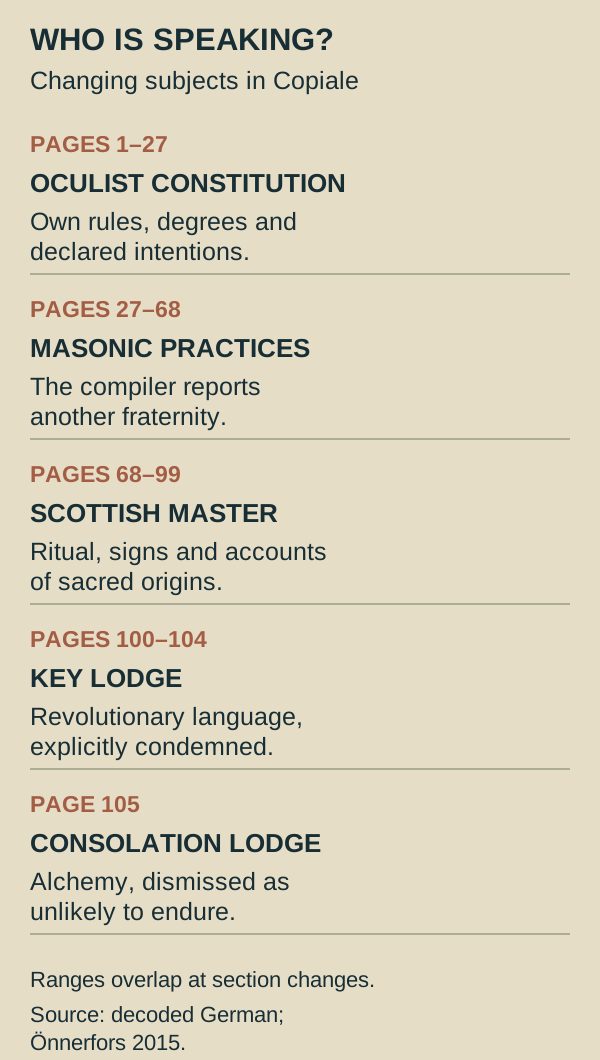
From page 27, the manuscript shifts into an extended account of Freemasonry. The contents are practical: rooms, furnishings, offices, admission procedures and the questions through which a brother’s knowledge might be tested. A lodge should ideally have separate spaces for assembling candidates, preparing them, conducting admission, and deliberating or recording business. These details make the compiler’s interest concrete. He is describing how a fraternity works, not merely collecting impressive names.5
The preparation of a Masonic candidate is more severe than the Oculist eye test. The account removes his metal possessions, uncovers part of his body and blindfolds him. Questions about his intentions and willingness precede entry. At a later point the blindfold comes off amid sudden brightness and surrounding sword points. Copiale describes a ceremony designed around controlled ignorance and revelation. It remains the compiler’s report of another group’s practice, rather than an independently observed meeting with named participants.5
A further portion concerns the Scottish master’s degree. It retells the story of Hiram and the lost master’s word, introduces sacred objects and describes recovered knowledge. Such narratives belong to the ritual’s claimed history. Their presence in an eighteenth-century cipher does not establish that a chain of modern lodges physically descends from the builders of Solomon’s Temple, or that a medieval recovery happened as the dialogue describes. The manuscript is evidence that the story was being transmitted.5
Önnerfors, in a 2015 conference paper, argued that this material should be read within early German fraternal culture. He favoured the middle or late 1740s for the contents, using internal references and comparisons with contemporary exposures and degrees. His account also considered a possible Jacobite reading of the political material. That is a historically situated hypothesis about the text, not a new decryption or a demonstrated plot. It depends on comparative interpretation after the words have become readable.4
The passage most easily turned into a revolutionary discovery comes near the end. Pages 100–104 describe a Key Lodge whose imagery includes a drum sounding for a general rising, weapons and a monstrous figure associated with domination. Its questions speak of natural freedom, tyranny and recovering what has been lost. A candidate is represented as born free and answerable to God rather than subject to human law. The political language is explicit enough to deserve attention.5
Yet the introduction to this section is equally explicit. The compiler calls the Key Lodge objectionable, attributes it to restless idlers and suggests that it has largely collapsed. The text is reporting a programme it disapproves of. To lift the subsequent language out of that frame and announce that the Oculists were plotting revolution reverses the stated relationship between reporter and subject. Reading the condemnation alongside the dialogue is essential to understanding who is supposed to believe what.5
This distinction sharpens the intrigue. Why collect a detailed account of a dangerous or ridiculous rival? Copiale does not explain every decision of its compiler. The inclusion may reflect the wider purpose of exposing and assessing fraternal secrets, but it does not establish personal participation. A report can preserve ideas that its author rejects. A cipher can protect a survey of other people’s subversion just as readily as it protects the writer’s own plans.
The final page gives the same lesson in a different form. A Consolation Lodge is described as an alchemical society concerned with fixing mercury, associated with Halle. The compiler dismisses it as unlikely to last and not worth further investigation. Then the text ends. Alchemy has genuinely appeared in the book, but so has a judgement against taking this particular association seriously. A catalogue of its most sensational subjects would conceal the opinions that connect them.5
What remains behind the eye
Copiale rewards reading across its divisions. The opening fraternity uses an eye test to confer belonging. Its masters learn a story exposing the weakness of people who chase secrets. Its later sections expose the ceremonies and claims of other associations. The book repeatedly stages the difference between the person who knows how something is arranged and the person who merely experiences it. A single label such as medical guild, Masonic ritual or revolutionary manual loses those changes of position.
There are also gaps that decipherment cannot repair. “Philipp 1866” does not identify the author, and a book copied in one period can preserve material from another. A constitutional account of an English origin is not a contemporary certificate from an English founder. The relationship between the surviving volume and the Wolfenbüttel material needs documentary comparison. No amount of confidence in a substitution key can supply a missing chain of ownership or turn a fraternity’s origin myth into an established event.15
The separate archive is valuable precisely because it moves the investigation beyond one enigmatic object. The project publishes additional Oculist texts from Wolfenbüttel, added in February 2012. One overlaps with the recognition signs, while a document headed Die Algebra explains features of the cipher under the cover of arithmetic instruction. These are distinct documents, not previously missing pages silently restored to Copiale. The project labels part of the extra material as uncorrected, a useful warning against treating every transcription detail as settled.89
The arithmetic document is particularly suggestive. Its directions explain the ordering of the cipher alphabet, treatment of letters and the doubling function of the colon. A text that looks like instruction in calculation also serves as instruction in protected writing. That connection reinforces the importance of the master’s literacy test. The cipher was an institutional skill that could itself be taught in another disguise, rather than a solitary writer’s private flourish.8
No surviving evidence examined here requires a supernatural explanation. The book contains unusual symbols because people selected them, and its ceremonies make their own mechanics unusually clear. Nor does a secret society automatically imply a hidden government. The manuscript’s ambitions concern recruitment, allegiance, rivalry and access to knowledge. Those are substantial subjects in their own right. Claims of an uninterrupted modern organisation or control over later revolutions would need evidence that these pages do not provide.
Its contemporary afterlife has taken a more demonstrable direction. In April 2026, Lei Kang and colleagues released a research preprint using Copiale to test systems that map images of cipher handwriting directly to German text. The experiment used aligned examples from an already deciphered manuscript for training and evaluation. It was an attempt to improve how historical writing is processed, not an announcement that the Oculists’ book had been solved again or that a new secret had emerged.10
That return to the page is appropriate. As of 6 November 2026, the project makes the manuscript’s images, transcription, decoded German and English translation available, alongside the related archive texts. The broad reading is established: an Oculist constitution followed by accounts of Masonic and other fraternal practices. Some rare symbols and historical relationships still require interpretation. The surviving volume’s precise authorship and dating should be kept separate from the successful decipherment of its language.13
The strongest next step would be a fuller comparison of the public constitution, related manuscripts and identified members, with access to the original objects where necessary. That could test how the lodge’s medical identity, recruitment practices and declared hostility to Masonic pretension fitted together. Copiale has already yielded the instructions for opening an initiate’s eyes. What remains is to identify more of the people who stood around him, knew the sheet was blank and decided when to replace it.
Follow the evidence
Sources & further reading
- The Copiale Cipher: project and downloadable texts Stockholm University; Beáta Megyesi · updated 2026-02-24 · Accessed 2026-11-06
- The Copiale Cipher Kevin Knight, Beáta Megyesi and Christiane Schaefer · 2011-06-24 · Accessed 2026-11-06
- The Secrets of the Copiale Cipher Kevin Knight, Beáta Megyesi and Christiane Schaefer · issue 2011; copyright 2012 · Accessed 2026-11-06
- Unveiling the Copiale-manuscript: layers of fraternalism, ritual and politics in eighteenth century Germany Andreas Önnerfors · 2015-05-29 · Accessed 2026-11-06
- Copiale manuscript: deciphered German, with original page markers Eighteenth-century manuscript; decipherment by Knight, Megyesi and Schaefer · German transcription August 2011 · Accessed 2026-11-06
- USC Scientist Cracks Mysterious Copiale Cipher USC Today · 2011-10-25 · Accessed 2026-11-06
- Language scholars solved 18th-century cipher Anna Malmberg; Uppsala University · 2011-10-27 · Accessed 2026-11-06
- Die Algebra: deciphered Oculist archive document Oculist archive, Wolfenbüttel; project transcription · 2012-02-04 · Accessed 2026-11-06
- Extra deciphered Oculist ritual and recognition signs Oculist archive, Wolfenbüttel; project transcription · 2012-02-04 · Accessed 2026-11-06
- Learning to Decipher from Pixels: A Case Study of Copiale Lei Kang, Giuseppe De Gregorio, Raphaela Heil, Alicia Fornés and Beáta Megyesi · 2026-04-26 · Accessed 2026-11-06