
On 6 July 1907, a messenger tried to unlock a safe in Dublin Castle and found it already open. Ireland’s crown jewels had gone. The police looked for a thief; the official inquiry would concentrate on the man who held the keys.
Jewels without a crown
There was no missing crown. The treasures at the centre of the affair were the diamond star and badge worn by the Grand Master of the Order of St Patrick. That office belonged to the Lord Lieutenant, the British monarch’s representative in Ireland. Five gold collars of the order disappeared with them. The name Irish Crown Jewels made the loss sound like a robbery from a coronation treasury, but these were the ornaments of a particular institution and a particular system of power.1
The order, founded in 1783, rewarded senior members of the Irish establishment. Its ceremonies connected aristocratic rank with the authority exercised from Dublin Castle. A man might be admitted to an exclusive order, have his heraldic identity recorded and receive insignia that displayed his place within that arrangement. The jewels were valuable in themselves. Their disappearance from the government’s own headquarters made them politically valuable too.2
Their most recognisable component was an eight-pointed star, its diamond rays surrounding an emerald shamrock and a ruby cross. The badge repeated the central design. Such objects were meant to be seen on ceremonial occasions, in portraits and at investitures. They were not anonymous stones until somebody removed them from their settings. Anyone contemplating a sale faced an immediate choice between preserving an identifiable treasure and destroying the identity that made it famous.12
For their custodian, heraldry was a profession rather than a decorative sideline. Sir Arthur Vicars had become Ulster King of Arms in 1893. The title placed him at the head of Ireland’s heraldic office, concerned with coats of arms, pedigrees and the ceremonial obligations of the order. His interests also reached into archaeology and local history. The National Portrait Gallery identifies him as an archaeologist, herald and genealogist. He was a recognisable public official, with a reputation beyond the room containing the safe.23
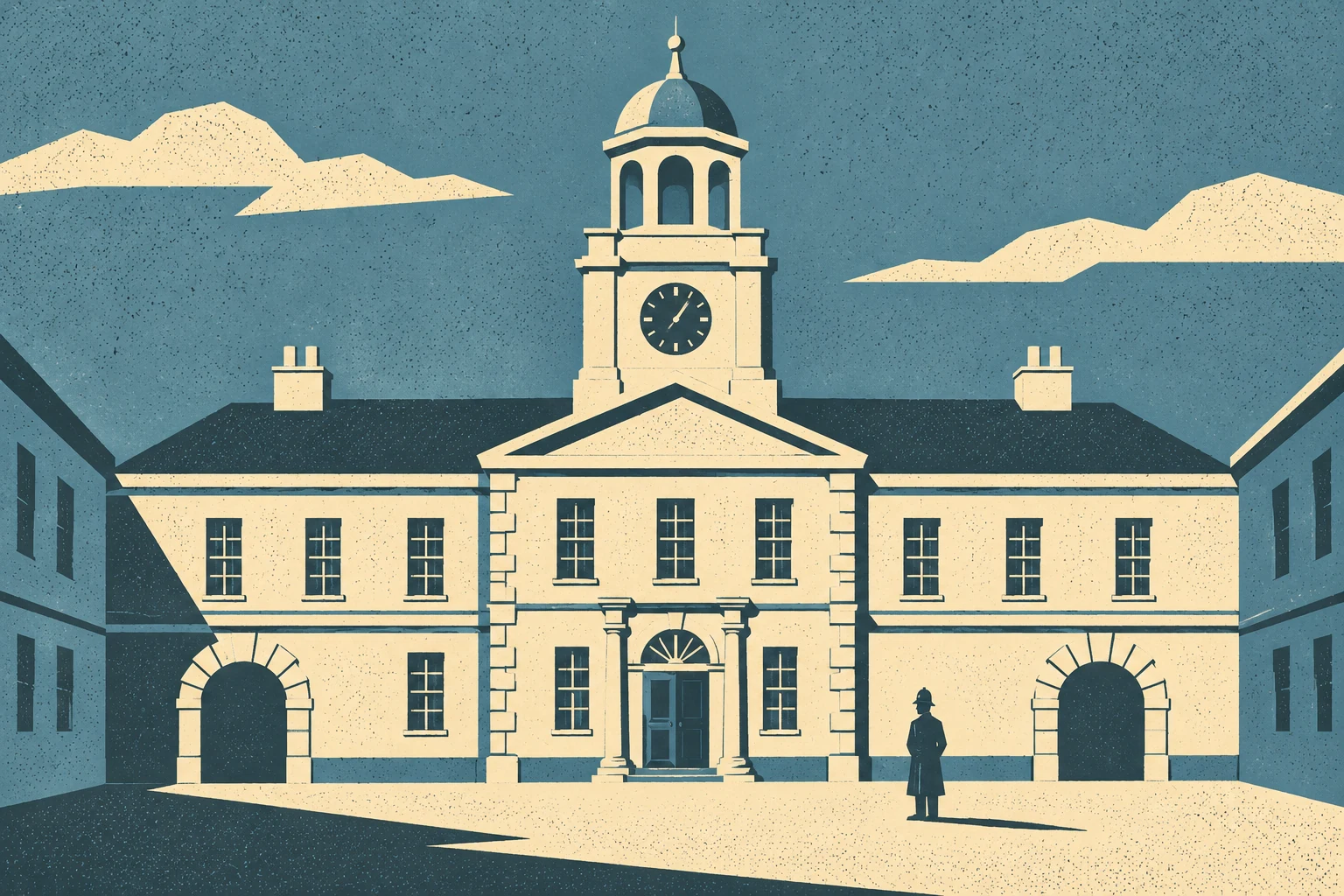
The Office of Arms occupied rooms in the Bedford Tower range overlooking the Upper Castle Yard. The familiar image of a guarded castle can obscure what that meant in practice. A government complex contained offices, visitors, staff and people whose presence attracted no particular attention. Guards around the complex did not personally supervise every cupboard or keep a continuous account of the contents of a herald’s safe. The difficulty was to protect a small collection within a working institution.4
There had already been a striking failure in those arrangements. When the office moved in 1903, its safe would not pass through the strongroom doorway. It remained in the library. The proposed replacement did not arrive before the theft. This was not an ingenious obstacle devised by a burglar. The institution had provided a protected room and then left the principal valuables outside it because the container did not fit.5
That detail deserves more than a smile at official incompetence. It separated the idea of security from its daily reality. Anyone hearing that the jewels were held in a castle, in the custody of a senior Crown officer, might imagine several independent barriers. In reality, the safety of the regalia depended heavily on an office routine and a very small number of keys. Once that routine failed, the surrounding ceremony offered little protection.
Edward VII was due to arrive in Dublin on 10 July 1907. The impending visit gave the discovery an especially damaging setting. These objects belonged to the ceremonial world the visit would put on display. Before the royal party arrived, officials had to confront the possibility that the jewels could not be produced at all. Nobody could say precisely how long they had been missing.4
Doors left open
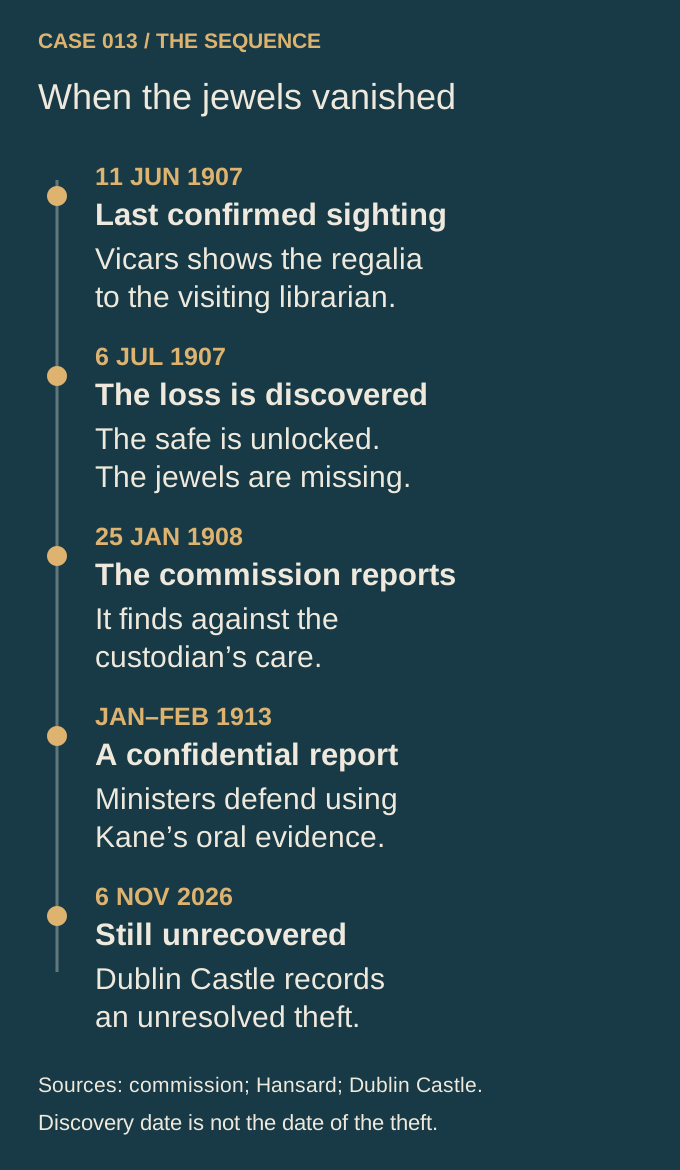
The last confirmed sighting was on 11 June. Vicars had shown the jewels to John Crawford Hodgson, librarian to the Duke of Northumberland. The discovery came on 6 July. Those dates establish an interval, not a night of the crime. On 1 April 1908, Chief Secretary Augustine Birrell repeated that interval in the Commons. It remains a basic restraint on any reconstruction: a suspect’s whereabouts on the day the loss was discovered do not, by themselves, settle what happened during the preceding weeks.6
Two incidents near the end of that interval caused particular concern. On the morning of 3 July, the cleaner, Mrs Farrell, found the outer office door unlocked. On 6 July, she found the strongroom door ajar. These were not the same door, and the strongroom was not the room containing the jewel safe. Later accounts sometimes compress them into a single dramatic breach. Keeping the locations separate matters when deciding what an intruder would have needed to open.5
Farrell passed on what she found. The messenger was William Stivey. The office hierarchy ran through people whose work could seem incidental beside the heraldic titles: the woman who arrived to clean, the man responsible for practical tasks, the senior official receiving their reports. In a theft reconstructed largely from access and routine, these ordinary observations became some of the most important evidence available. They recorded something wrong before the missing jewels were formally discovered.7
Vicars did not respond with the urgency the commissioners later thought necessary. His explanation was that preparations for the royal visit had occupied him and that the timing of one report had not registered properly. It was a defence of distraction, rather than a denial that the doors had been found open. Whether the openings were warnings, mistakes or part of somebody’s plan, the opportunity for an immediate check passed.7
The discovery itself arose from a routine request. A collar belonging to a deceased knight had been returned. Vicars gave Stivey a key and asked him to put the item in the safe. Stivey found that the safe was already unlocked. Vicars then opened it and discovered the loss. The distinction between trying a key, finding an unlocked mechanism and opening the safe can sound pedantic. Here it identifies what each man could actually report.47
Alongside the regalia and collars, diamonds belonging to Vicars’s mother had disappeared. This was therefore not simply the removal of an emblem from a public collection. Private property stored under the same protection had gone too. The mixture complicates any claim that the thief selected only a political symbol. It does not rule out a political motive, but it gives the straightforward pursuit of valuables an obvious place in the investigation.4
An unlocked safe presents a more troublesome problem than a smashed one. Damage can suggest tools, an entry method or a hurried attempt. A safe opened without visible violence directs attention towards familiarity, opportunity and permission. Which key had been used? Who could have borrowed it? Had the person entering the office looked like an intruder to anyone else? None of those questions required the thief to be a salaried employee. A visitor with inside assistance could also fit the broad pattern.
By August the affair was being used against the government in Parliament. Patrick O’Brien asked what police had done to investigate the establishment figures who frequented the relevant social world. Birrell refused to speculate about the thieves’ politics. The exchange shows how quickly an unsolved theft could become an argument about who was entitled to be above suspicion. It did not identify the thief, but it established the political difficulty of keeping the inquiry narrow.8
Who held the keys?
The lock evidence favoured access over force. Examinations found no marks consistent with picking or crude interference. The technical distinction was between a rough duplicate taken from an impression and a key matching the original closely enough to operate the mechanism without leaving the expected traces. A proper key, or a sufficiently exact equivalent, remained the central explanation. The absence of damage did not tell investigators whose hand had turned it.7
There were two known keys to the jewel safe, both under Vicars’s control. One was carried by him; the other was kept at his home in Clonskeagh. There were more keys to the outer office. These were separate levels of access. Being able to enter the office did not necessarily mean being able to open the safe, just as possessing a safe key did not explain how someone entered and left the castle unnoticed.2
For an investigator, that arrangement made Vicars important in several different capacities. He was custodian, witness, possible source of access and an official whose conduct required examination. Those roles must not be collapsed into an accusation. A person may lose control of a key without knowing it, permit casual access without intending a theft, or fail to notice something that a determined associate has concealed. Negligence can create the opportunity for a crime while remaining distinct from participation in it.
The police interpretation was not a conventional break-in by a stranger. In January 1913, Birrell told Parliament that the Dublin police and Scotland Yard’s John Kane agreed on a person or persons with intimate knowledge of the Office of Arms. He also stated that evidence sufficient for a criminal charge against an individual had not emerged. The general theory and the failure to name a prosecutable suspect were both part of the official account.9
What about the doors left open? One interpretation was that somebody wanted to bring about discovery of a theft already committed. An open door might prompt a check while making the loss appear recent. The later North Otago Times account described that police theory: someone familiar with the office had taken the jewels earlier, then taken steps to attract attention to their absence. That is a more complicated proposal than an intruder simply forgetting to shut up behind him.10
What did investigators have? A confirmed sighting on 11 June, discovery on 6 July, an unforced safe and reports of open doors. None fixed the day of the theft or identified the hand that used the key.67
It also remains an interpretation. If a door was deliberately left open to trigger discovery, the person responsible need not automatically have been the person who removed the jewels. Someone might have known of a loss without possessing them. The theory raises questions about motive and timing; it cannot answer them through the state of a latch alone. A reconstruction must explain why the proposed action benefited a particular person, rather than treating an unusual detail as a signature.
Nor did a closely matching key automatically establish that Vicars knowingly lent his own. Temporary access, copying from an original and the use of an accomplice are different possibilities. A convincing account would need evidence connecting one of those mechanisms with an identifiable person and the relevant interval. Otherwise the apparent precision of the lock evidence can disguise how many human arrangements remain possible behind it.
The record also illustrates a familiar problem with an investigation that survives in public argument. On 26 November 1912, Birrell said all available information had long been in police hands. That was an assurance about the handling of the case. It was not a demonstration that every useful lead had been followed or every witness tested. Critics could challenge the adequacy of the investigation, but criticism alone could not supply the missing chain from key to thief to sale.11

A verdict without a trial
The official response that ended Vicars’s career was a viceregal commission. It began meeting in January 1908 under Judge James Johnston Shaw, with Robert Starkie and Chester Jones. Its task included assessing whether Vicars had exercised proper care as custodian. The inquiry was not a criminal court trying a named defendant for theft. That limitation is essential to understanding both its findings and the anger they provoked.5
Vicars wanted an inquiry with powers the commissioners did not possess. His counsel objected to the procedure, including the inability to compel witnesses and take evidence on oath. Vicars withdrew. That left the commissioners using his previous statements alongside evidence from other witnesses, without his participation in the hearing itself. A reader may regard that decision as principled, tactically disastrous or both. It reduced his ability to answer the case developing against his administration.5
A contemporary criticism came from The Spectator on 18 January 1908. The magazine objected to secrecy that allowed rumours to circulate while preventing a convincing public examination. Its concern was not merely whether an official had been careless. A private or partial process could damage the reputations of people who had no effective means of answering the allegations gathering around them. The criticism belongs to the affair’s own time, rather than being imposed by later mystery writers.12
The resulting report found against Vicars’s care of the regalia. His dismissal did not amount to a conviction for stealing them. Dublin Castle’s exhibition records his replacement by Sir Nevile Rodwell Wilkinson. The institution had removed the official responsible for their custody, but it had neither recovered the jewels nor supplied a criminal verdict against anyone. That left a gap between the administrative answer and the question the public wanted answered.4
The distinction was still being argued in 1913. Asked why a public inquiry on oath had not been held, Birrell said statutory authority would have been needed and that the police investigation already provided no reason for another inquiry. That was the government’s position. It explains the procedural defence without proving the decision wise. A body could be legally limited and still be an inadequate way to settle suspicions generated by a serious crime.13
Staff changes added another layer of confusion. In February 1913, Birrell explained that reconstruction of the Office of Arms had involved the retirement of the Dublin Herald and Athlone Pursuivant. Personal employees lost their employment when Vicars left. These departures are sometimes made to sound like coded admissions of guilt. The minister’s account described a reorganisation. Neither continued employment nor removal from office should be treated as a substitute for evidence about participation in the robbery.14
The inquiry did do something that later critics found remarkable: it expressly rejected the suggestion that Francis Richard Shackleton had stolen the jewels, on the evidence before it. That was narrower than a criminal acquittal after a contested prosecution, but stronger than silence. Anyone now presenting Shackleton as the obvious thief must account for that official assessment rather than omitting it to make the story easier to tell.5
Was Vicars a scapegoat? The word can describe an official made to carry more than his share of blame. It need not mean that every criticism of him was false. The security failures were serious, while the wider institutional arrangements also deserved scrutiny. Removing the custodian produced a visible consequence. It did not establish whether others had exploited his failures, whether an investigation had been deliberately restricted, or where the stolen property had gone.
Shackleton and the accusation
Francis Shackleton was the Dublin Herald and a former housemate of Vicars. His brother Ernest was becoming famous as a polar explorer. Frank belonged to the social world surrounding the office and knew its custodian personally. Those connections made him a plausible subject for inquiry. They did not establish a route through the safe or a transaction disposing of the jewels.2
His later financial troubles helped keep suspicion alive. A contemporary report of his examination in bankruptcy in 1911 returned to the jewels affair and his relationships with people who had defended him. That is evidence of how closely his reputation had become tied to the earlier scandal. A later difficulty with money might invite questions about motive, but it could not retrospectively identify the person who entered an office years before.15
In November 1912, when Shackleton was in custody on another criminal matter, Laurence Ginnell raised the theft in Parliament. The Attorney-General refused to make a potentially prejudicial statement while that case was pending. The refusal can look evasive when quoted without its setting. In context, it was also a recognisable response to a person awaiting criminal proceedings. The parliamentary record distinguishes the new case from the unresolved theft rather than treating them as a single prosecution.16
The same separation is necessary after conviction. On 19 February 1914, Earl Winterton asked whether Shackleton’s conviction justified a judicial inquiry into the crown jewels. Birrell replied that he could not order such an inquiry. The question demonstrates the persistence of suspicion. It does not show that the conviction established Shackleton’s role in the 1907 robbery. He was not convicted of that offence.17
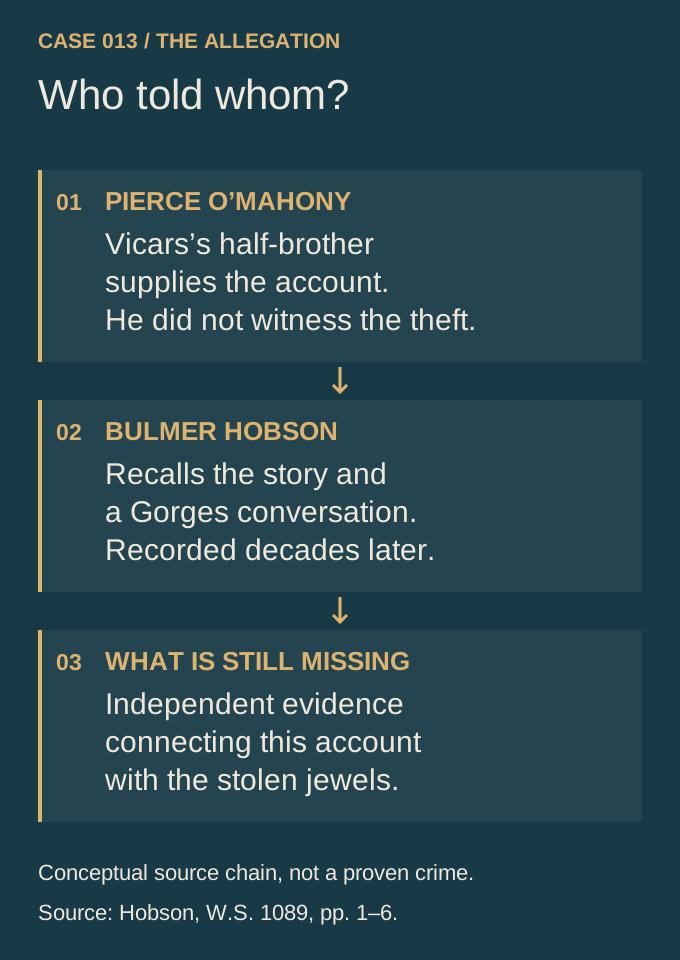
The most vivid account against him came from the nationalist journalist Bulmer Hobson. In a statement recorded for the Bureau of Military History in 1955, Hobson described a story initially supplied by Pierce O’Mahony, Vicars’s half-brother. It alleged that Shackleton and Captain Richard Gorges obtained access while Vicars was incapacitated by drink, then disposed of the jewels in Amsterdam. Hobson also recalled a later conversation in which Gorges corroborated the account. This was testimony about information received and a remembered encounter, not Hobson witnessing the robbery.18
There is a substantial problem in treating it as a finished solution. Hobson began by warning that he was relying on memory after more than forty years. The document contains mistakes in offices and chronology. Its source chain ran through a defender of Vicars, while Hobson acknowledged his interest in discrediting Dublin Castle. Those facts do not make every allegation untrue. They do require the reader to distinguish a compelling narrative from a contemporary, independently corroborated account.18
What independent evidence would make that account stronger? A dated movement of the jewels, an authenticated payment, a dealer’s record or a separately documented confession could connect the story to the missing objects. The remembered account supplies a mechanism and names. It does not, in the material examined here, supply that final connection. Amsterdam is a reported destination in the allegation, not a location to which investigators traced and recovered the regalia.
Shackleton therefore remains a suspect in the historical literature, with serious allegations against him and significant obstacles to proving them. The commission’s contrary assessment cannot simply be dismissed because later events made him look disreputable. Equally, that assessment does not put every aspect of his connection to Vicars beyond historical inquiry. The unresolved task is to move from opportunity and accusation to evidence of the particular theft.
Was a scandal being buried?
Suspicion of a cover-up did not begin on a modern internet forum. Ginnell made it explicit in the Commons in December 1912. He alleged that police had uncovered sexual misconduct involving people whose exposure would embarrass the establishment, and that the government had protected them. He attacked the inquiry as a device for avoiding that reckoning. His speech is direct evidence that this allegation was being publicly made, not independent confirmation that the alleged bargain occurred.19
Fear of exposure could have given a blackmailer leverage. The existence of that leverage in a particular case still needs to be demonstrated. Edwardian scandal could turn accusations about private life into supposed evidence of general corruption. It is possible to investigate whether fear of exposure influenced officials without adopting the language or assumptions of those accusations. A claim about blackmail requires evidence of a threat and a response. A claim about a theft requires evidence connecting a person with stolen property.
Birrell answered the charge on 20 December 1912. He denied that he was protecting known criminals or withholding a solution to prevent exposure of a scandal. Ginnell named Gorges and Shackleton during the exchange. The minister’s reply belongs beside the accusation whenever the debate is used as a source. Reporting only the dramatic charge would turn a contested parliamentary argument into an apparent official admission.20
There was, however, a tangible issue behind the dispute about openness. Kane’s written report was not submitted to the commission. In January 1913, Birrell confirmed its date as 16 July 1907, described it as confidential and refused independent inspection. He argued that Kane had given oral evidence and answered questions. Critics wanted the written account compared with that testimony. The existence of the disagreement is established; the assumption that the report named a protected thief is not.13
“His report is a confidential document and an independent examination of it cannot, therefore, be permitted.”
On 6 February the government explained the point again. Thomas Russell said the report had been addressed to Scotland Yard’s Criminal Investigation Department in the ordinary confidential course. Kane had attended the inquiry and given oral evidence on its contents. No special instructions had been given beyond attending and testifying. That was an official explanation for the omission, and it leaves a real historical question: did oral testimony adequately replace the written report?21
One can doubt that it did without knowing what the report contained. A written document preserves order, emphasis and information that questioning may not bring out. On the other hand, refusing to circulate a confidential police report is not, by itself, proof of a secret agreement with a thief. To establish that stronger claim would require evidence about the decision and the information being concealed, rather than the fact of confidentiality alone.
The argument also outlived repeated rumours of recovery. On 12 December 1912, Birrell denied that the jewels had been restored. Asked again in January whether replacements had been received, he said they had not. These were distinct possibilities: recovering the originals, buying substitutes and concealing their continued absence. Contemporary questions show the rumours were circulating. The answers do not prove a secret return; they explicitly deny one.229
The puzzle is therefore larger than a choice between believing every minister and believing every accuser. The official record contains secrecy, procedural limits and repeated failure. The alternative accounts contain named allegations, personal loyalties and uncertain recollections. Each has to be tested at the point where it makes a factual claim. Neither acquires a complete answer merely because the other has weaknesses.
Other suspects, other stories
Francis Bennett-Goldney, Athlone Pursuivant, is the other herald regularly drawn into the affair. He later became MP for Canterbury and had been honorary director of the city’s museum and public library. After his death, books and documents belonging to Canterbury were found among his effects. In 1921 the city obtained an order for their return. That episode gives his name a particular attraction in accounts of a missing collection.23
The judicial distinction is important. As the History of Parliament’s account explains, the judge did not find deliberate wrongdoing, describing a failure to return material removed in an official capacity. The same account notes that Bennett-Goldney was absent from Ireland during the interval between the last confirmed sighting and the discovery of the theft. Neither circumstance rules out every imagined involvement, but neither supports presenting him as a proved jewel thief.23
A thief can certainly act through an accomplice. The danger is using that possibility whenever an awkward fact appears. If absence from Ireland leads automatically to an unseen agent, and no evidence of an agent leads to a particularly effective conspiracy, the theory becomes impossible to test. An alternative involving Bennett-Goldney needs a link to this property, not merely an unrelated dispute over ownership elsewhere.
The controversy also generated a defamatory story for which there was a legal reckoning. A London newspaper suggested that Vicars had enabled a woman associated with him to obtain a key and carry off the jewels. He sued and received £5,000 damages. A later newspaper account recorded the defence’s admission that the story had no foundation. This is one branch of the mystery with an important resolution: it should not be revived as an equally viable explanation merely because the principal theft remains unsolved.10
Nor can Lord Haddo, the Lord Lieutenant’s son, be inserted into the theft without addressing the chronology. In April 1908 Birrell stated that Haddo had left Dublin on 7 March 1907 and had remained in Scotland and London for months. He repeated his rejection of the allegation in February 1913. Later tales about an earlier prank are a different proposition from personal participation in the disappearance discovered that July. A story can connect the two in a memorable way without establishing that connection as fact.614
Political explanations broaden the field further. A humiliating theft from the seat of British administration offered obvious propaganda value. That made it possible to imagine nationalists taking the jewels to embarrass the government, or opponents of Home Rule arranging a scandal to damage political rivals. The broad outlines of such rival interpretations appear in specialist accounts. A political benefit, however, is a motive someone might have had, not proof of an operation they carried out.24
The supposed afterlife of the jewels is equally uncertain. Michael Nash’s 1999 account drew attention to a memorandum from 1927 indicating that Castle jewels might be bought. He treated it as a possible sign that the stolen pieces remained intact. Seán Murphy’s centenary research questioned that reading: the words could concern other surviving regalia of the Order of St Patrick. The article has not authenticated an original offer or inspected the objects supposedly offered. The memorandum therefore remains a lead about terminology and provenance, not a sighting of the stolen star.2425
Such distinctions are easy to lose when the story is told as a treasure hunt. A rumour that property is for sale needs an identified seller; a claim that stones survived needs recognisable objects; an alleged route abroad needs a traceable transaction. Without those links, the jewels can be imagined in a private collection, in altered settings or somewhere in Ireland. These remain different possibilities, not cumulative evidence for a single hidden destination.
A missing collection, an unfinished file
Vicars did not recover his former position. On 14 April 1921 he was shot dead by the IRA at Kilmorna House in County Kerry, and the house was burned. Local historical research describes conflicting accounts of the killing and competing explanations, including suspicion that he was an informer and disputes surrounding the estate. His death was a real and separate episode in the War of Independence. It does not establish that someone was silencing him over the jewels.26
His bitterness about the theft and his treatment endured. The catalogue of the National Library of Ireland identifies a substantial collection of his correspondence and other papers concerning the loss, GO MS 507. Another catalogue entry records correspondence about criticism of the private inquiry. These holdings matter because the surviving record is wider than a handful of familiar anecdotes. A catalogue establishes that material exists; it does not mean every document has been read or that a missing answer lies inside it.2728
As of 6 November 2026, Dublin Castle’s account continues to describe the theft as unsolved and the jewels as unrecovered. No criminal conviction has established who took them. The most defensible working explanation remains access by someone with intimate knowledge of the office, or help from such a person. That describes the likely conditions of the theft more securely than it identifies a culprit.19
There are still specific questions worth pursuing. A complete reconstruction would compare the relevant key movements, the evidence about who was present and the surviving correspondence against each named theory. Any claimed recovery would need to establish the identity and provenance of the objects, rather than repeat a rumour about a sale. Any claim of official protection would need to show what was known, who decided to withhold it and why.
The mystery survives at those points. An unlocked safe, an inquiry into the custodian and decades of accusation have produced several persuasive stories. None has yet supplied the missing property or a demonstrable chain of events from Dublin Castle to its destination. The institution found a man to dismiss. The thief remained unidentified.
Follow the evidence
Sources & further reading
- The Theft of the Irish Crown Jewels Jennifer Duffy, Dublin Castle · undated · Accessed 2026-11-06
- The Theft of the Irish Crown Jewels, 1907 Tomás O’Riordan, History Ireland · 2001; online archive · Accessed 2026-11-06
- Sir Arthur Edward Vicars National Portrait Gallery · collection catalogue · Accessed 2026-11-06
- The King’s Room: Splendour and Scandal Dublin Castle · online exhibition · Accessed 2026-11-06
- Circumstances of the Loss of the Regalia of the Order of Saint Patrick: report, Cd. 3906 Viceregal Commission; HMSO · 1908 · Accessed 2026-11-06
- The Theft of the Dublin Crown Jewels House of Commons, Hansard · 1908-04-01 · Accessed 2026-11-06
- Minutes of evidence: appendix to the report, Cd. 3936 Crown Jewels Commission; HMSO · 1908 · Accessed 2026-11-06
- The Theft of the Irish Crown Jewels House of Commons, Hansard · 1907-08-13 · Accessed 2026-11-06
- Crown Jewels (Ireland) House of Commons, Hansard · 1913-01-28 · Accessed 2026-11-06
- Irish Crown Jewels: Stolen from Castle, Unexplained Mystery North Otago Times, page 6, via National Library of New Zealand · 1929-09-11 · Accessed 2026-11-06
- Theft of Crown Jewels, Dublin Castle House of Commons, Hansard · 1912-11-26 · Accessed 2026-11-06
- During the week an informal Commission has been sitting in secret The Spectator, page 3 · 1908-01-18 · Accessed 2026-11-06
- Crown Jewels (Ireland) House of Commons, Hansard · 1913-01-23 · Accessed 2026-11-06
- Crown Jewels (Dublin) House of Commons, Hansard · 1913-02-13 · Accessed 2026-11-06
- Mr F. R. Shackleton Otago Witness · 1911-12-13 · Accessed 2026-11-06
- Crown Jewels, Dublin Castle: charge against Francis Richard Shackleton House of Commons, Hansard · 1912-11-18 · Accessed 2026-11-06
- Crown Jewels (Dublin) House of Commons, Hansard · 1914-02-19 · Accessed 2026-11-06
- Witness Statement W.S. 1089 Bulmer Hobson, Bureau of Military History · 1955-02-10 · Accessed 2026-11-06
- Irish Crown Jewels House of Commons, Hansard · 1912-12-06 · Accessed 2026-11-06
- Crown Jewels, Dublin House of Commons, Hansard · 1912-12-20 · Accessed 2026-11-06
- Dublin Castle House of Commons, Hansard · 1913-02-06 · Accessed 2026-11-06
- Irish Crown Jewels House of Commons, Hansard · 1912-12-12 · Accessed 2026-11-06
- MPs in World War I: Francis Bennett-Goldney Kathryn Rix, History of Parliament · 2018-07-26 · Accessed 2026-11-06
- A Centenary Report on the Theft of the Irish Crown Jewels in 1907 Seán J. Murphy, Centre for Irish Genealogical and Historical Studies · 2008 · Accessed 2026-11-06
- Who Pinched the Irish Crown Jewels? Michael Nash, British Heritage · 1999-09-23 · Accessed 2026-11-06
- The Killing of Sir Arthur Vicars in April 1921 Kevin Murphy, Kildare Local Studies · 2021-04-14 · Accessed 2026-11-06
- A collection of letters and other papers concerning the loss of the Irish Crown Jewels: GO MS 507 National Library of Ireland · 1907–1908; catalogue · Accessed 2026-11-06
- Correspondence concerning the theft of the Irish Crown Jewels National Library of Ireland · 1908-03; catalogue · Accessed 2026-11-06